
Artemis II astronauts prepare for re-entry, splashdown near San Diego after historic moon flyby
Artemis II astronauts are preparing for re-entry and splashdown Friday near San Diego following a historic 10-day mission flying by the moon.
Coverage for this event has ended.
NASA looks ahead to Artemis III after successful mission
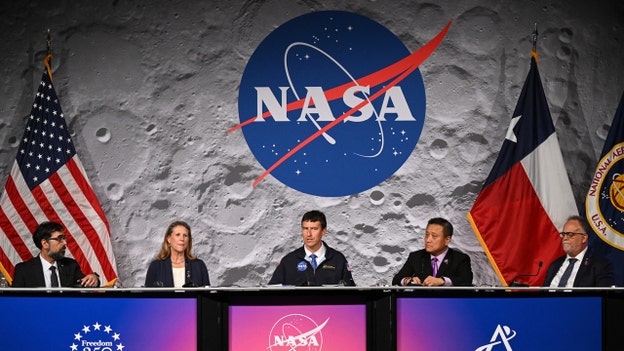
Now that the Artemis II astronauts have safely returned to Earth, NASA is already eyeing its next mission.
Artemis II entry flight director Rick Henfling said during a news conference Friday evening that the agency is preparing for its next flight.
The Artemis III mission, currently scheduled for 2027, will involve testing a lunar lander from SpaceX, Blue Origin, or both, while in Earth's orbit, according to NASA.
“We'll take the lessons learned from Artemis II,” Henfling said. “We learned a bunch on how to fly people in space, both from a vehicle operations, but also from how to run a control room with a deep space mission.”
“And when the time is right, we'll get back into flight-specific training,” he added.
The Artemis II mission was the first crewed mission beyond low Earth orbit since 1972.
NASA is planning a return to the lunar surface as part of its Artemis IV mission in early 2028.
NASA official hopes Artemis II mission inspires kids to ‘pursue the dreams’

Orion Program Manager Howard Hu said Friday evening that he hopes the Artemis II mission will inspire children across the country, noting that NASA has “a lot of missions ahead.”
The four Artemis II astronauts splashed down in the Pacific Ocean off the coast of San Diego at 5:07 p.m. local time Friday, completing their 10-day mission around the moon.
During a news conference at the Johnson Space Center in Houston, Hu shared how his passion for the space program began as a child after watching Star Wars with his father.
“He's not alive today. I wish he was, because that little kid who saw and was inspired by the stars — and now we're able to send our crew out to the stars, the farthest any humans have been,” he said.
Hu added, “I can't even express just how I feel and the goosebumps I have.”
He then delivered a message for children who tracked the Artemis II mission: “I would say that for all the kids out there, just pursue the dreams.”
Hu added, “Hopefully those kids who are in love with human spaceflight, in love with going to the stars, will be inspired by us, especially by our crews.”
“And come join NASA, come work for us. We got a lot of missions ahead.”
NASA says 286 Orion components to be reused after Artemis II mission
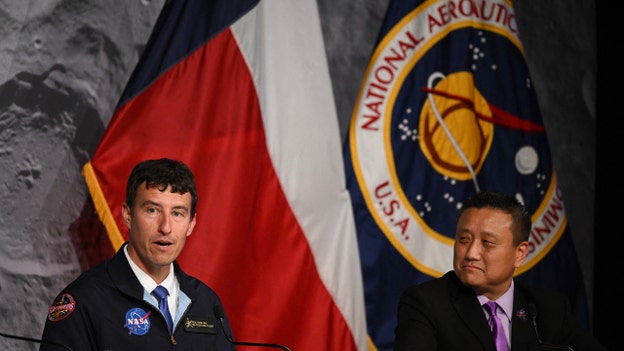
Orion Program Manager Howard Hu said Friday evening that 286 components of the Orion spacecraft will be reused in future missions.
“We've got about 286 components we're going to reuse in future missions already and then we're going to look at other components and determine if we can reuse those as well,” he said during a news conference. “A lot of work, not only on the hardware flow, but also all the analysis of the data that we're going to need going forward to learn from this mission and carry forward for Artemis III and beyond.”
Artemis II entry flight director Rick Henfling shared statistics from the completed mission.
Henfling said the Artemis II astronauts traveled a total of 700,237 miles, reaching a peak velocity of 24,664 mph.
The Orion capsule hit its flight path angle target within 0.4% and splashed down less than a mile from its target, he added.
NASA says Artemis II astronauts ‘happy and healthy’ after return to Earth
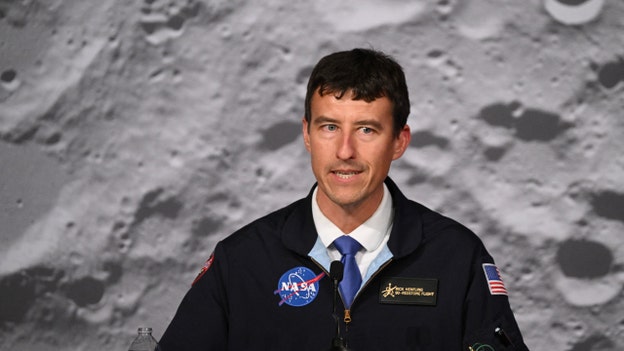
NASA provided an update on the Artemis II astronauts Friday evening after the crew returned to Earth.
Rick Henfling, Artemis II entry flight director, said during a news conference at Johnson Space Center in Houston that the four astronauts are “happy and healthy.”
Henfling said Pilot Victor Glover had been sitting on the flight deck of the USS John P. Murtha recovery ship and was in “good spirits.”
“Everything we've been hearing from the surgeons is the flight crew is happy and healthy and ready to come home to Houston,” he said.
Now that the astronauts were back, Henfling shared what their first days on Earth would look like.
“The top priority is going to be to get them promptly back to their families here in Houston,” he said. “As far as the specifics, I'm sure each of the crew members has something special planned with their families, and that'll be the priority is for them to take some time and spend with their loved ones.”
NASA anticipates the astronauts will arrive in Houston between 7 a.m. and 7 p.m. local time.
Artemis II astronauts exit space capsule after splashdown
The four crew members of the Artemis II mission were seen exiting the Orion capsule off the coast of San Diego after their historic mission around the moon.
The astronauts were taken to the USS John P. Murtha, will be medically evaluated, and then flown to the Johnson Space Center in Houston.
What will happen to the Orion spacecraft after its 'textbook' splashdown?
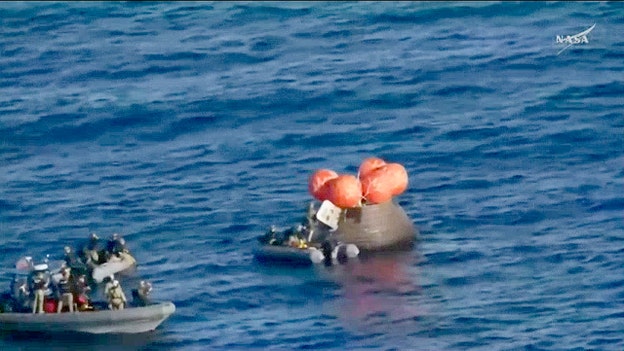
After the Orion spacecraft successfully made splashdown shortly after 5:00 p.m. PT and the Artemis II crew was retrieved, its history-making journey isn't over yet.
According to NASA, the Recovery Director will instruct Navy divers to attach cables to pull the spacecraft onboard a Navy ship.
A winch line will connect to up to four additional tending lines which will pull Orion into a "specially designed cradle" inside the ship's well deck.
Once Orion is positioned above the cradle, the well deck is drained and open water personnel will work to recover both the spacecraft's forward bay cover and three main parachutes.
If the jettisoned cover and parachutes are recovered, engineers can inspect hardware and gather data from the landmark mission.
From there, all hardware and the spacecraft will be transported to a pier at U.S. Naval Base San Diego.
When the Orion spacecraft is officially recovered at the Recovery Transportation Fixture, a platform NASA has nicknamed "the Armadillo," it will be moved by truck to Kennedy Space Center.
What happens to the Artemis astronauts after extraction from their capsule
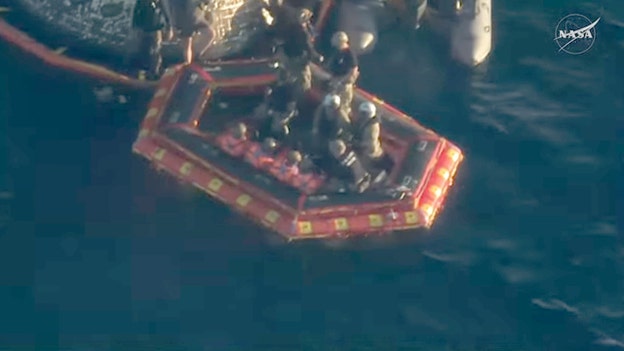
After the Artemis II astronauts were successfully extracted from their crew capsule following their planned splashdown in Southern California at 5:07 p.m. local time, they will be taken by raft, then helicoptered to the nearby USS John P. Murtha ship where they will start getting medical checks.
They will then be flown to NASA’s Johnson Space Center in Houston where they will continue to adapt to Earth’s gravity.
They will also be reunited with their families.
President Trump touts Artemis II crew after splashdown, hints they'll be 'at the White House soon'
President Donald Trump celebrated the successful return of the Artemis II and her crew Friday night in a Truth Social post, saying he'll be seeing them "at the White House soon."
"Congratulations to the Great and Very Talented Crew of Artemis II," Trump wrote. "The entire trip was spectacular, the landing was perfect and, as President of the United States, I could not be more proud! I look forward to seeing you all at the White House soon."
The president hinted at future NASA operations in closing.
"We’ll be doing it again and then, next step, Mars!"
Artemis II astronauts successfully recovered after splashdown
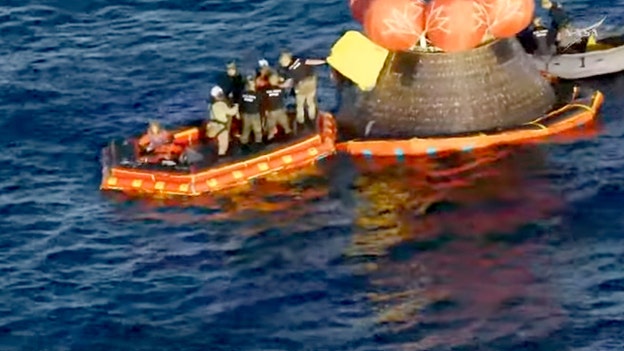
The four crew members from the Artemis II mission have been successfully recovered following splashdown.
The astronauts splashed down in the Pacific Ocean off San Diego at 5:07 p.m. local time following a 10-day mission around the moon.
After being removed from the crew capsule, the astronauts were taken on board the USS John P. Murtha and will start getting medical checks.
Recovery forces seen approaching Artemis II after splashdown
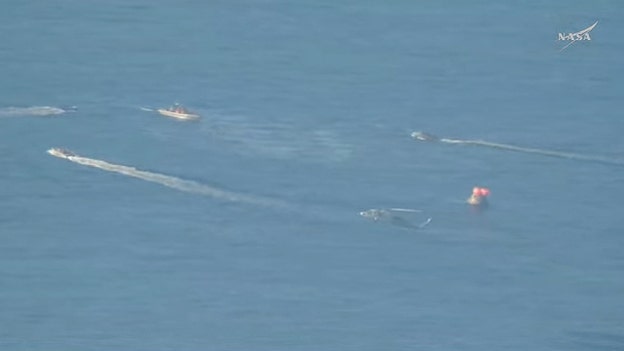
After the Artemis II crew splashed down into the Pacific Ocean at 5:07 p.m. PT off the coast of Southern California, recovery forces were seen approaching the capsule before their removal.
Here’s how NASA will extract Artemis II astronauts after dramatic ocean splashdown
After Artemis II's "textbook" splashdown landing off the coast of San Diego just after 5:00 PT Friday, NASA has released the game plan for how each of the astronauts onboard will be retrieved for medical exams.
According to NASA, Mission Specialist Christina Koch will be the first to be hoisted into "helicopter one," with Pilot Victor Glover extracted afterward into "helicopter two."
After the first two astronauts are successfully rescued, Mission Specialist Jeremy Hansen will join Koch onboard helicopter one and Commander Reid Wiseman will be hoisted into helicopter two.
The helicopters will then transfer the crew of Artemis II to the USS John P Murtha recovery ship, which is expected to be about five miles away from the spacecraft at the time of splashdown.
Once crew is on the ship, the astronauts will undergo exams at the medical bay.
After preliminary medical exams, the Artemis II crew will be flown to the San Diego Naval Air Station, where they will take a NASA plane to Johnson Space Center.
Artemis astronauts splash down in Pacific Ocean after 10-day moon mission
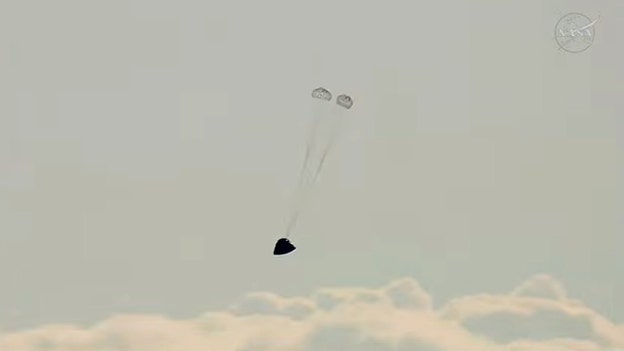
The four Artemis II astronauts splashed down in the Pacific Ocean off the coast of San Diego at 5:07 p.m. local time Friday evening following their 10-day mission around the moon.
The crew members will be helped out of their capsule by a Navy dive team and they will be taken aboard the USS John P. Murtha where they will start getting health checks.
Artemis crew has reentered Earth’s atmosphere
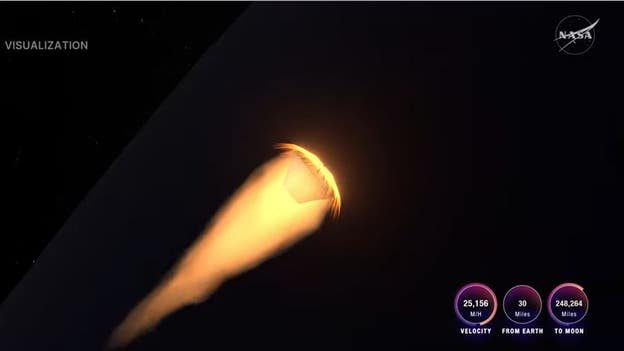
The Artemis II crew is back in Earth’s atmosphere as they prepare for splashdown.
During the reentry, there was a six-minute communication blackout.
Artemis crew reentering Earth’s atmosphere
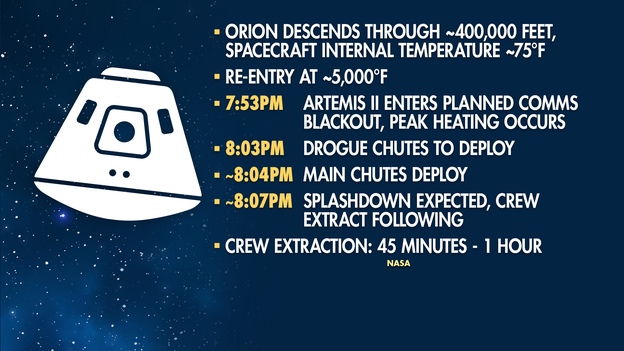
The Artemis II crew is reentering the Earth’s atmosphere, traveling at nearly 25,000 mph as they prepare for splashdown in the Pacific Ocean.
During this period, there will be a six-minute communication blackout while they travel through the atmosphere.
NASA Administrator Jared Isaacman applauds ‘historic’ moon mission, says US back in moon business
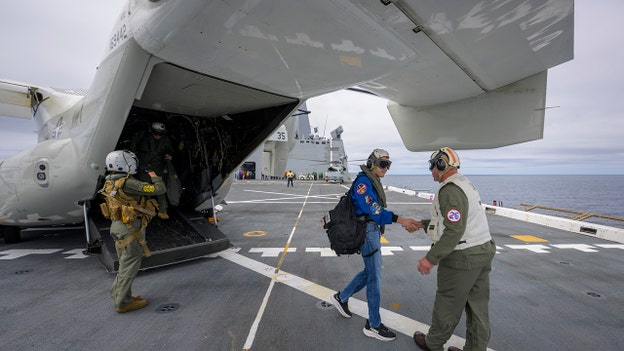
After landing on the USS John P. Murtha ship, which the Artemis astronauts will board following splashdown, NASA Administrator Jared Isaacman told service members “We are back in the business of sending astronauts to the moon again.”
“I have no doubt that you're all going to execute this flawlessly as we get these astronauts who will just complete an absolute historic mission, traveling further into space than any humans have gone before,” he said on board the ship.
“For the first time, we've gone into the lunar environment in more than half a century,” he added. “We are back in the business of sending astronauts to the moon again.”
Isaacman continued, “We must. We have a geopolitical rival that's challenging us right now … Success and failure right now is going to be measured in months, not in years. So we are going to stay in this business.”
He said once Artemis III launches for a moon landing in 2028, “This time we're going to stay, we're going to build the moon base. We are never giving up. Thank you all for your contributions. Very grateful.”
NASA's Artemis II crew readies for return and splashdown
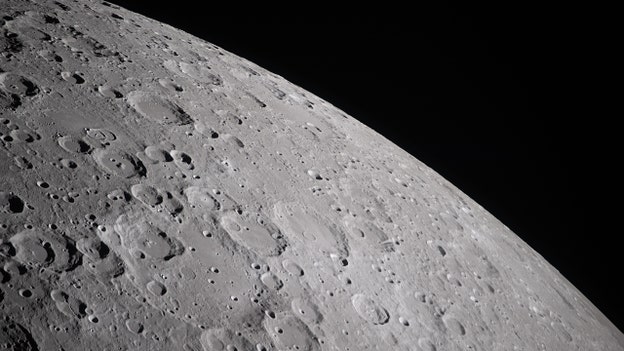
The Artemis II crew has put on their launch and entry suits and completed their leak checks ahead of their splashdown off the coast of San Diego Friday evening, NASA’s Mission Control said.
Weather conditions at the splashdown site are also a “go.”
NASA Mission Control says return trajectory burn ahead of splashdown was ‘perfect’
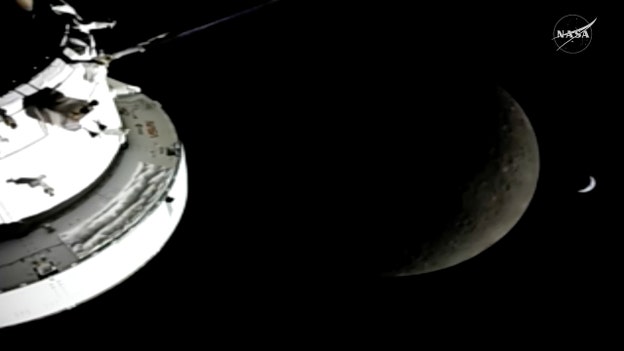
As the Artemis II astronauts prepare to splash down off the coast of San Diego Friday evening, the NASA commentator said the return trajectory burn conducted a couple of hours ago was “so perfect that we are dead on the centerline down the corridor… our trajectory is dead set right on the money, right down the pike."
He called the burn “basically a final fine tuning of the trajectory of integrity to hit the sweet spot in the corridor over the Pacific Ocean.”
The commentator added that the crew module raise burn scheduled at 6:37 p.m. CT, “is only required to lift the aft end of the vehicle ever so slightly by a degree or two, to improve the angle of attack of the spacecraft as it enters the atmosphere, mitigating peak heating effects on the heat shield for integrity.”
He said splashdown is still expected at 8:07 p.m. ET.
NASA press secretary says ‘safety is our utmost priority’ ahead of splashdown
NASA press secretary Bethany Stevens says that “safety” is NASA’s “utmost priority” as the Artemis II crew prepares for splashdown Friday evening.
She said the weather is looking good as the crew prepares to come down off the coast of San Diego.
“The crew has trained for this for over three years, so we are excited to have our friends and colleagues splash down and come back here home,” Stevens told Fox News.
Stevens said NASA changed the heat shield to a hexagonal shape after the unmanned Artemis I mission returned with damage.
“It’s been through extensive testing here on Earth since Artemis I to make sure our crew is safe,” she said. “Of course, we would not send up our crew into space unless we had faith they were in the safest hands. Safety is our utmost priority. And we are confident in our ability and Mission Control’s ability to make sure they splash down safely.”
She added that NASA scientists believe the heat shield has a greater degree of resistance and it will keep the astronauts insulated throughout reentry.
NASA Administrator Jared Isaacman arrives at USS John P. Murtha before splashdown
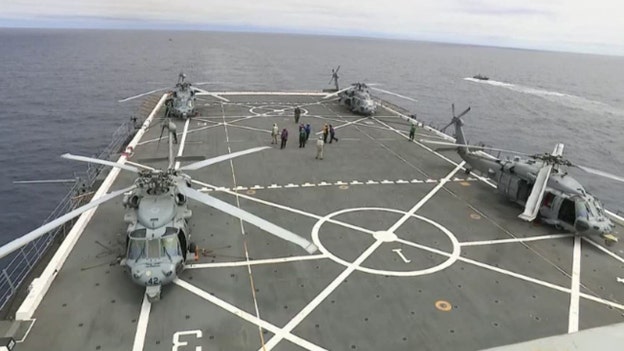
The Osprey carrying NASA Administrator Jared Isaacman landed on the USS John P Murtha at 4:08 p.m. ET ahead of the Artemis II splashdown off the coast of San Diego.
The splashdown is expected at 8:07 p.m. ET.
Weather conditions look good for splashdown
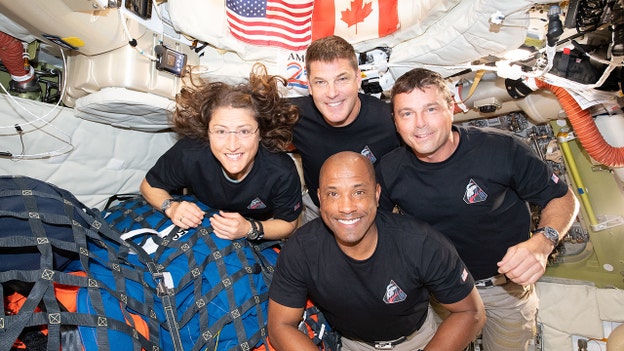
Weather conditions look perfect ahead of the Orion crew’s splashdown Friday evening off the coast of San Diego, according to FOX Weather.
NASA has strict weather rules for splashdown: There can’t be precipitation or thunderstorms within 35 miles, significant wave height must be under six feet, and winds should be less than 25 knots.
Previously, light rain in the area could have impacted the splashdown zone, with NASA saying that it would have to find a new area to touch down if it rains.
The Pacific Ocean off San Diego is usually fairy calm and the wave height and winds near the surface are not expected to be a factor, according to FOX Weather.
The U.S. Geological Survey (USGS) said a sonic boom is expected to be heard and felt throughout Southern California between 5 p.m. and 5:15 p.m. PT.[4:33 PM]
Orion reentry timeline
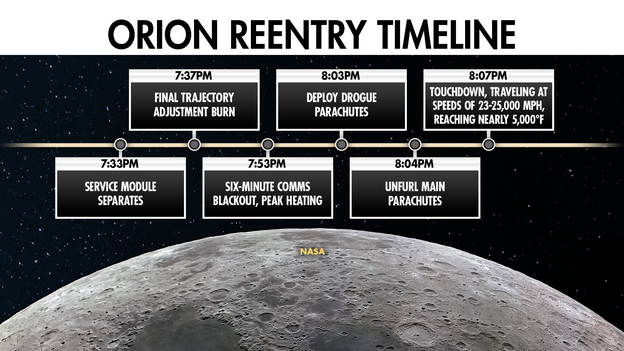
As the four astronauts in the Orion spacecraft prepare for splashdown off the San Diego coast Friday evening, the service module will separate from the crew module around 7:33 p.m. ET before it enters the Earth’s atmosphere, then the astronauts will begin their final trajectory adjustment burn at approximately 7:37 p.m. ET.
Around 7:53 p.m. ET there will be a six-minute communication blackout as the temperature around the heat shield will peak at around 5,000 Fahrenheit.
At 8:03 p.m. ET, the drogue parachutes will be deployed, the main parachute will be deployed at 8:04 and at 8:07 p.m. ET, they are expected to touch down after reaching speeds of 23,000 to 25,000 mph.
Artemis program head says she’ll breathe easy when astronauts are back on Earth getting medical care
Dr. Lori Glaze, the head of NASA’s Artemis program explained that the Orion spacecraft has to come in at just the right angle when the astronauts return to Earth Friday evening to ensure the heat shield keeps the crew at the right temperature inside.
It will reach temperatures of 5,000 Fahrenheit and around 25,000 mph before slowing down to 20 mph before they splash down.
“Were coming in really fast,” Glaze told Fox News Friday afternoon. “We kind of hit the top of the atmosphere about 75 miles above the surface and we take a little skip and we come back in. That allows us to slow down a little bit, absorb a little bit of the heat and then we come back in very quickly, and then we begin that descent.”
She said it was a carefully choreographed maneuver.
“I probably won’t take a big breath and relax until I know all four crew members are safely aboard the USS Murtha and in the medical bay --- I know they’re being seen by medical professionals, are going to be taken care of, and then I can probably start breathing a little easier,” Glaze said when asked when she’ll breathe easier.
Glaze added that in the 2028 Artemis III mission, the astronauts will be landing near the moon’s south pole.
“The south pole is completely unexplored,” she explained. “No one has been there before. And the thing that’s so interesting about south pole is we believe there is frozen water ice underneath the surface. So, we may be able to with establishing a base, not only do incredible science on the surface of the moon, but also be able to take advantage of that water ice and perhaps use it as a resource, that we don’t have to actually bring water with us.”
NASA says 'go' for Artemis engine burn
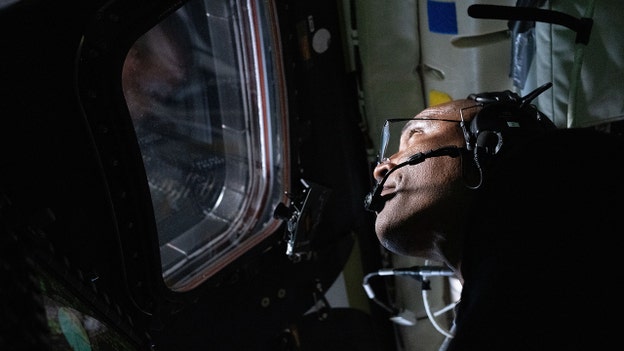
NASA’s Mission Control gave the go ahead Friday afternoon for the astronauts in the Orion spacecraft to conduct their scheduled return trajectory correction burn ahead of their planned splashdown off the coast of San Diego just after 8 p.m. ET.
The burn was scheduled for 2:53 p.m. ET. And completed by 3 p.m., with Mission Control saying it looked “good.”
Navy dive recovery team will be first to greet astronauts, conduct medical evals after splashdown

The astronauts will be greeted by four Navy service members after they splash down off the coast of San Diego Friday evening.
The members of the U.S. Navy dive medical recovery team include Lt. Cmdr. Jesse Wang of Laguna Beach, California, who is a board certified emergency doctor; Senior Chief Hospital Corpsman Laddy Aldridge of Cushing, Oklahoma; Chief Hospital Corpsman Vlad Link of Chealsea Massachusetts, who has 18 years of dive medicine experience; and Hospital Corpsman 1st Class Steve Kapala of Alpena, Michigan, who has practiced dive medicine for eight years.
Aldridge will be the one who opens the capsule after splashdown.
The service members will enter the capsule and conduct health evaluations, including triage if necessary.
Then, the astronauts will be assisted into an inflatable raft set up by Navy divers and be airlifted by Helicopter Sea Combat Squadron back to the USS John P. Murtha for more medical evaluations.
“I have been exposed to the Navy since I was a young teenager, and I’m proud to represent both my family and hometown,” Link said in a statement. “Contributing our efforts to NASA and the Artemis II mission is something we take great pride in as part of that legacy.”
'Pretty violent': former astronaut warns of grueling re-entry for Artemis II crew
The Artemis II crew will experience a grueling return home once they re-enter Earth’s atmosphere, a former NASA astronaut said.
Col. Jeff Williams said the parachute sequence will be “pretty violent” until the main chutes open and the four astronauts splash down in the Pacific Ocean on Friday evening.
“I can tell you from my experience, that’s the longest... let's say, minutes of your life—getting to that parachute opening,” Williams told “America Reports."
The buildup of g-force will put immense pressure on the crew as they descend toward Earth, he said.
“You’re weightless until you enter the upper parts of the atmosphere, and then you start feeling just a little bit of an acceleration,” said Williams. “If you drop your pencil, instead of floating in front of you, it’ll start falling slowly, and then quicker and quicker. Then it builds up to those four Gs... so if you weigh 200 pounds, you feel like 800 pounds.”
Artemis II astronauts wake up to Live’s 'Run to the Water' for final day in orbit
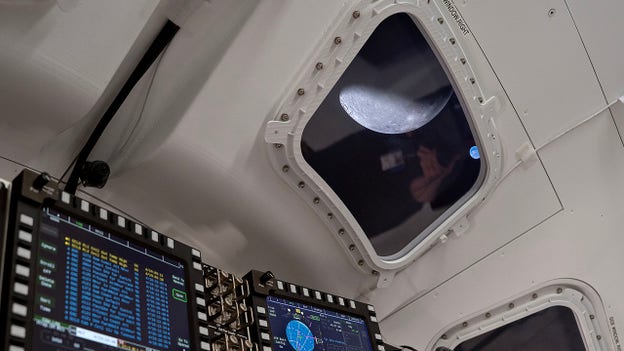
The crew of Artemis II woke up to their last day in space Friday to "Run to the Water" by Live.The song was played by mission control, NASA said.
Each day, the four astronauts have woken up aboard the Orion spacecraft to songs they selected for their 10-day voyage.
Wakeup songs have been a longstanding tradition in space exploration for more than 50 years, according to NASA.
NASA gives shoutout to Mission Control workers as Artemis II mission prepares for re-entry

As the nation eagerly awaits Friday night return of the astronauts aboard the Artemis II mission, NASA shined a spotlight on those working at Mission Control in Houston, Texas.
"Behind the four astronauts of Artemis II are hundreds of people tracking their every move: monitoring spacecraft systems, evaluating crew safety, and staying in constant communication. Let’s hear it for the team in Mission Control responsible for getting the astronauts around the Moon and safely home," NASA noted in a post on X.
"The path around the Moon runs through Houston, where Mission Control at Johnson Space Center is on watch," a post on the space center's X account stated.
NASA says Artemis II re-entry, splashdown involves '13 minutes of things that have to go right'
The spacecraft returning from traveling around the moon is slated to splash down around 8:07 p.m. off the San Diego coast, according to NASA --- but a lot needs to happen in the final minutes of the flight before the Artemis II crew can finally breathe a big sigh of relief and disembark.
At a press conference on Thursday, Artemis II lead flight director Jeff Radigan detailed 13 crucial minutes from entry interface to splashdown.
"It's 13 minutes of things that have to go right is the way I think about it," he said. "I have a whole checklist in my head that we, you know, were going through of all the things that have to happen, you know, the forward bay cover has to come off, the drogues have to come out, the main chutes have to deploy, the reefing systems have to cut, and we have to get touch down angle alignment correct. And, and then hit the water correctly."
"And even prior to that, we have the CM/SM Sep, separation between the service module and the crew module," he added. "That has to go right. And then you have the heat shield that has to work. So it's not so much 13 minutes. It's more in my head about an hour and a half of things that have to go right."
A Thursday post on NASA's website explains what will happen in the leadup to the splashdown.
"During re-entry, the service module will separate around 7:33 p.m., about 20 minutes before Orion reaches the upper atmosphere southeast of Hawaii. At 7:37 p.m., a final trajectory‑adjustment burn will fine‑tune the flight path before the spacecraft begins a series of roll maneuvers to safely distance itself from departing hardware. Orion will reach its maximum velocity — approximately 23,864 mph — just before entry interface," the post notes.
"As Orion descends through about 400,000 feet, the spacecraft will enter a planned six‑minute communications blackout at 7:53 p.m. as plasma forms around the capsule during peak heating. The crew is expected to experience up to 3.9 Gs in a nominal landing profile," according to NASA. "After emerging from blackout, Orion will jettison its forward bay cover, deploy its drogue parachutes near 22,000 feet at 8:03 p.m., and then unfurl its three main parachutes around 6,000 feet at 8:04 p.m. to slow the capsule for splashdown off the coast of San Diego."
Artemis II crew will soon make high-temp re-entry to earth's atmosphere
While the Artemis II crew have already successfully flown around the moon and broken the all-time record for traveling the farthest distance from earth, their Orion spacecraft will soon make a blazing hot descent through the earth's atmosphere during re-entry before splashdown on Friday night.
A heat shield allows for this high-temperature re-entry, but the Artemis I Orion spacecraft's uncrewed flight around the moon in 2022 led to issues with the heat shield.
"Engineers determined as Orion was returning from its uncrewed mission around the Moon, gases generated inside the heat shield’s ablative outer material called Avcoat were not able to vent and dissipate as expected. This allowed pressure to build up and cracking to occur, causing some charred material to break off in several locations," NASA noted in 2024.
But NASA associate administator Amit Kshatriya said during a Thursday news conference ahead of the Artemis II crew's Friday splashdown that there is "high confidence" regarding the heat shield and that "tomorrow the crew's gonna put their lives behind that confidence."
Artemis II crew set to splashdown off the San Diego coast on Friday night

After flying around the moon and setting the record for the farthest distance ever traveled from earth during their historic mission, the Artemis II crew is slated to splashdown on Friday night.
“NASA is targeting splashdown at 8:07 p.m. (5:07 p.m. PDT) Friday, April 10, off the coast of San Diego,” NASA has noted.
“At 10:53 p.m. EDT, the Orion spacecraft ignited its thrusters for 9 seconds, producing an acceleration in velocity of 5.3 feet-per-second and pushing the Artemis II crew toward Earth,” NASA explained. “The third return trajectory correction burn is scheduled for April 10 at about 1:53 p.m. ahead of re-entry procedures.”
Live Coverage begins here