
Trump says Iran deal 'imminent'; planned strike would've been largest since World War II
President Donald Trump said he called off what he described as the largest planned U.S. military operation since World War II after Saudi Arabia, the United Arab Emirates and Iran urged diplomacy. Negotiations are now set to begin Monday afternoon.
Coverage for this event has ended.
US military 'locked and loaded,' ready for action at levels not seen since WWII, Hegseth warns
War Secretary Pete Hegseth said Sunday U.S. forces remain on alert and are prepared to act, underscoring how President Donald Trump's decision to delay a strike on Iran has not affected military readiness.
“Fact,” Hegseth said in a post on X alongside a video of the president.
“The @DeptofWar was ready to go — and remains ready — at levels not seen since World War II,” he added before stating that the military was “locked and loaded.”
His comments came after the president told reporters that a planned strike on Iran, "would be the biggest attack since World War II," Trump had said while returning from Bedminster, New Jersey.
Trump was also asked whether Tehran faced a deadline to reach an agreement.
"No. We'll just see — we'll just see how it is," he said. "We're ready to go anytime we want," he declared.
Oil tumbles as Trump delays Iran strike, pushes nuclear, Hormuz talks with Tehran
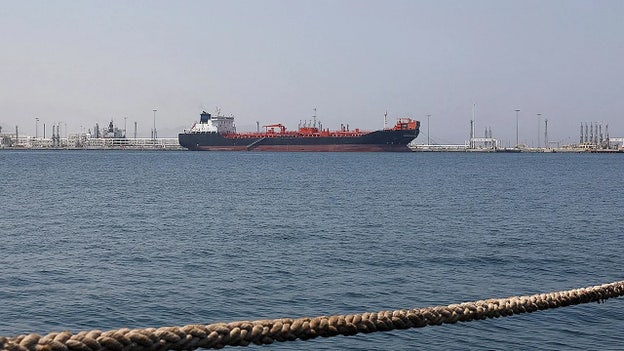
Oil prices fell more than $5 a barrel after President Donald Trump delayed a planned strike on Iran to allow time for talks aimed at ending Tehran's nuclear program and reopening the Strait of Hormuz to commercial tankers.
Brent crude futures fell $5.52, or 6.28%, to $82.41 a barrel as of 2202 GMT, while U.S. West Texas Intermediate crude dropped $5.27, or 6.22%, to $79.40 a barrel, Reuters reported.
On Sunday, discussions between Iran and Oman over the Strait of Hormuz had got underway and were reported to be in their final stages, Iranian Foreign Minister Abbas Araghchi said. Meanwhile, Trump said talks between Washington and Tehran were planned for Monday afternoon.
Board of Peace chief says ‘intense efforts’ underway after strikes across Gaza
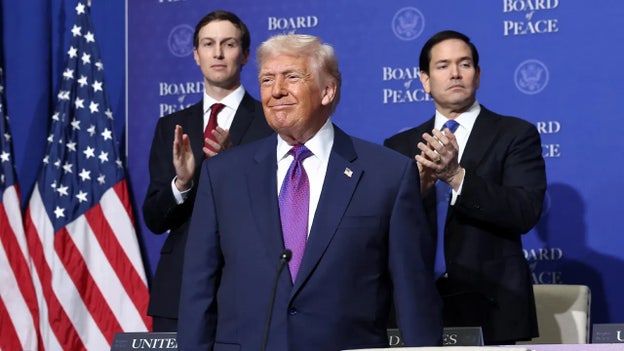
The director general of the Board of Peace said Sunday that attacks in Gaza over the weekend have "killed civilians and destroyed medical supplies that people depend on."
His comments came three days after President Donald Trump announced that Hamas and the Board of Peace had agreed to a road map calling for Hamas to disarm and for Israeli troops to withdraw from the Gaza Strip in phases under a U.S.-brokered ceasefire plan.
Nickolay Mladenov said the attacks came after "intense efforts by the @BoardOfPeace and the mediators (Egypt, Turkey, Qatar and the U.S.) to bring the Palestinian factions in Gaza to agree to a road map on the full implementation of President Trump's plan, to hand over civilian governance and to decommission their weapons."
Both parties, he said, remain bound by obligations under the Comprehensive Plan and the Sharm El Sheikh deal that secured the release of all hostages.
"My team and I are working around the clock with the parties, the mediators and regional partners to de-escalate and create the space for the full implementation of the President's plan," Mladenov said in a post on X.
He added that achieving a "lasting peace is hard but achievable if everyone makes their best efforts."
Iran deal 'imminent' as regime divides over Hormuz, nuclear talks: Trump
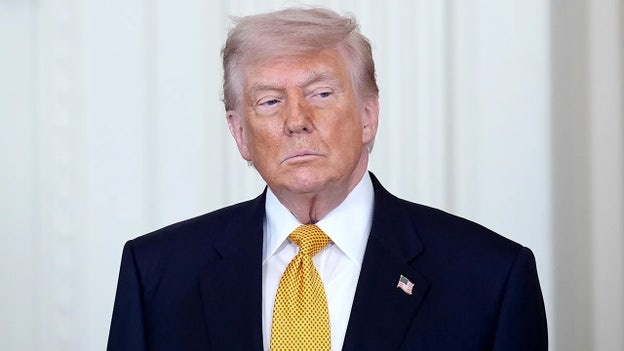
President Donald Trump said Sunday that a deal with Iran over the Strait of Hormuz and its nuclear program is near while claiming competing factions inside the Iranian regime remain divided.
"The deal is imminent, having to do with the Hormuz Strait and also, ultimately, the denuclearization of Iran," Trump told reporters aboard Air Force One.
"When I hear that, I say, 'Well, we want to go and do this.' There is a group of people that would like to just do it. And there's another group of people that does not want me to do it."
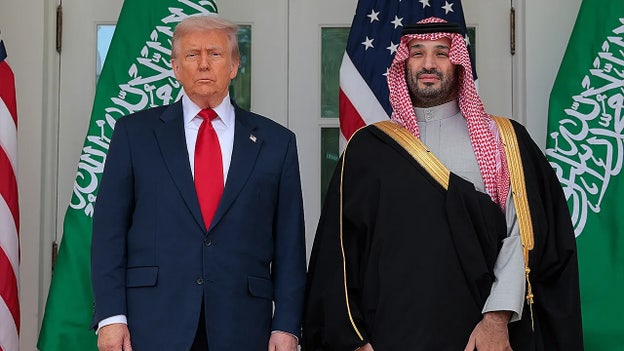
President Donald Trump / Saudi Crown Prince Mohammed bin Salman / Chip Somodevilla / Getty Images
Trump also discussed Saudi Arabia, saying the kingdom would prefer diplomacy over military action.
"We would much prefer a deal as opposed to an attack because you don't know where these attacks lead," Trump said before referencing regional allies, including Saudi Arabia's crown prince, Mohammed bin Salman Al Saud.
Trump said the Saudi crown prince would "much prefer a deal as opposed to an attack because you don't know where these attacks lead."
"I mean, will they be flooded with people pouring into their country?" Trump said. "A disaster. There are a lot of bad things that can happen."
"I mean, will they be flooded with people pouring into their country?" Trump said. "A disaster. There are a lot of bad things that can happen."
Trump says Iran strike would have been biggest since WWII, announces talks begin Monday
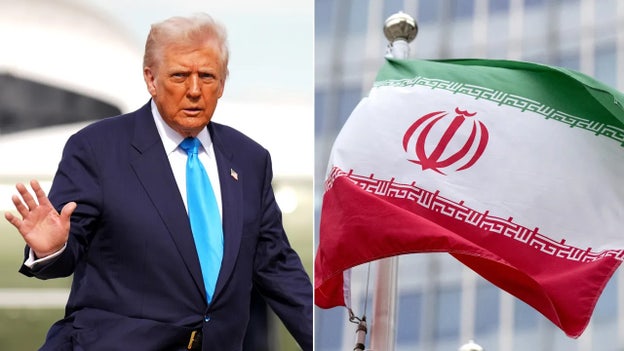
President Donald Trump said Sunday that a planned attack on Iran was called off after officials from Saudi Arabia, the United Arab Emirates and Iran urged the U.S. to give diplomacy another chance.
Speaking to reporters aboard Air Force One on a return flight from New Jersey, the president described how the strike was halted and said negotiations are scheduled to begin Monday afternoon.
“I was asked by Saudi Arabia, the UAE and by Iran. We were all set to go. Just about at this time. Right now," he said.
“The reason they asked is they think there's a deal.
“They said we'd like to make a deal now. You know, I don't know what they say because a lot of times they'll say that for me.
“Obviously they don't want to be attacked,” Trump added before saying Washington was “talking to them” and that negotiations were planned for "tomorrow afternoon."
“It would be the biggest attack since World War II,” Trump said before adding, “It would have been disastrous for them.”
Saudi Arabia, Iran hold high-level call as Gulf states push to reduce regional tension
Saudi Arabia's foreign minister, Prince Faisal bin Farhan, and Iranian Foreign Minister Abbas Araghchi discussed efforts to reduce tensions in the Middle East during a call Sunday, according to the Saudi Foreign Ministry.
The two officials reviewed "the latest developments amid the current situation" and discussed "diplomatic efforts to reduce escalation," the ministry said in a statement shared on X.
Bin Farhan also affirmed Saudi Arabia's commitment to continuing its role in "promoting security and stability in a manner that serves the shared interests of all countries and peoples of the region," the ministry added.
Pezeshkian says US must honor the memorandum of understanding
Iranian President Masoud Pezeshkian urged the United States to uphold the memorandum of understanding signed between the two countries, calling it the foundation of Tehran's future foreign policy as mediation efforts continued.
“I believe this memorandum will be the center of gravity of our foreign relations in the future,” Pezeshkian said in a post shared on X.
“We must strive to compel the enemy to remain committed to what it has signed,” he said, adding that the security of Iran, the region and its allies will be “enhanced by this memorandum.”
His remarks came as The Associated Press reported that Washington and Tehran have renewed calls to return to negotiations focused on reopening the Strait of Hormuz and halting attacks across the region, including strikes by Iranian-backed militias in Iraq targeting Persian Gulf countries and Jordan.
Citing an official, the outlet reported that, in exchange, the United States would end its blockade of Iranian ports and allow Tehran to resume oil exports under the terms of a tentative ceasefire proposal, but no deal had yet been reached.
Citing an official, the outlet reported that, in exchange, the United States would end its blockade of Iranian ports and allow Tehran to resume oil exports under the terms of a tentative ceasefire proposal, but no deal had yet been reached.
US maritime blockade of Iran redirects 35 commercial ships, CENTCOM says
U.S. Central Command (CENTCOM) said Sunday it had redirected 35 commercial vessels and disabled two others during its ongoing blockade of Iranian ports.
“A U.S. Marine Corps F-35C stealth fighter jet launches from the USS Abraham Lincoln (CVN 72) as the aircraft carrier transits the Arabian Sea and supports the U.S. blockade against Iran,” the command said in a post on X.
“As of Aug. 2, CENTCOM had redirected 35 commercial vessels, disabled two, and boarded two,” it added.
The U.S. initially imposed the blockade April 13 and resumed it July 14 after a pause.
Terhan says Hormuz negotiations with Oman in final stages after US pauses strikes
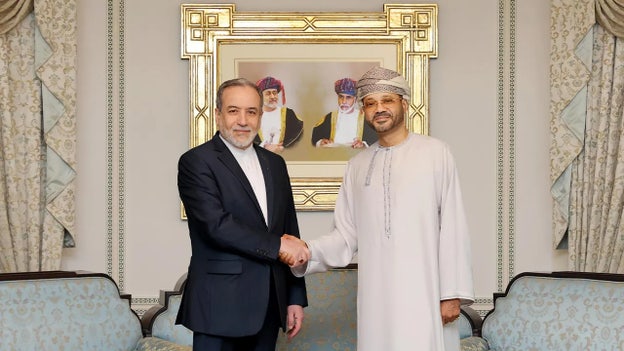
Negotiations between Iran and Oman over the Strait of Hormuz are in their final stages, Iranian Foreign Minister Abbas Araghchi said Sunday, according to Reuters.
Citing Iran's state-run IRNA news agency, the outlet said the announcement followed the United States calling off a planned attack on Iran to allow more time for diplomacy.
Araghchi did not provide details about the negotiations, Reuters said.
According to Iran International, mediators are also working to revive the 14-point memorandum of understanding (MOU) between Iran and the United States.
"The central issue and the key to the matter is the Strait of Hormuz," Hassan Ghashghavi, a spokesperson for the Iranian parliament's National Security Committee, said, according to the outlet.
"Discussions are underway, and there is a possibility that the Iranian side will return to Muscat," he said, referring to Oman's capital.
"Exchanging views and discussing proposals are part of diplomacy, and it is natural for each side to seek the greatest possible benefit for itself," Ghashghavi added.
Bombshell report suggests China's involvement in Iran war
Retired Brig. Gen. Mark Kimmitt joined 'The Sunday Briefing' to analyze President Donald Trump's decision to cancel strikes on Iran subject to a deal as well as reports of China supplying weapons to Iran.
Fox News' Jennifer Griffin reported last week on allegations that China is sending air defense missile launchers to bolster Iran's air defense systems amid its war with the U.S.
Chevron CEO warns Iran conflict has created 'very real' threat to oil supplies as gas prices rise
Chevron CEO Mike Wirth warned of "very real" dangers for the global oil industry as tensions escalate in Iran and Houthi attacks on Saudi oil facilities fuel concerns over a potential new shipping crisis.
His comments come as oil prices climb following President Donald Trump’s pause on U.S. strikes against Iran and as Saudi Arabia reportedly builds an international coalition to protect vital shipping routes.
"We now see, not only the Strait of Hormuz, but the Red Sea and the Black Sea have risks and uncertainties. So, some of the challenges have expanded, and the risks to supply are very real," Wirth said during an appearance on "Sunday Morning Futures."
While oil demand remains strong around the world, Wirth said energy markets are "fragile and uncertain" as the U.S. conflict with Iran festers into a sixth month and as global inventories continue to decline.
"The world energy system has been stressed and the need for supplies to markets and customers has never been higher," the Chevron CEO said.
The Strait of Hormuz, one of the world’s most vital trade routes, is one of the most contentious aspects of the United States conflict with Iran. Traffic has sunk to only a handful of vessels passing through the waterway each day.
This is an excerpt from an article by Fox News' Nora Moriarty.
Saudi Arabia takes action to prevent escalation in Red Sea
Sen. Bill Hagerty, R-Tenn., joined Fox News to discuss President Donald Trump’s cancellation of strikes on Iran as well as Saudi Arabia’s role in preserving Middle East security on Sunday.
The Saudi government convened a meeting last week with Kuwait, the U.K., Qatar and other regional powers to discuss ways of preventing military escalation in the Red Sea amid regional tensions.
Chevron eyes Iraq project to bypass Strait of Hormuz
Chevron CEO Mike Wirth joined "Sunday Morning Futures" to discuss rising oil and gas prices amid the U.S.-Iran conflict, saying his company is already looking at potential options to bypass the Strait of Hormuz.
Lankford torches 'lying' Iranian regime over Middle East attacks
Sen. James Lankford, R-Okla., reacted to President Donald Trump's decision to pause military strikes against Iran and more on "Fox News Sunday."
Iran's leadership remains divided as peace talks begin once again
Iran's leadership remains deeply divided over negotiations with the U.S., with the most radical factions in Tehran arguing that talks shouldn't take place at all.
Leading the furthest fringes is the Islamic Revolutionary Guard Corps representing the "Paydari" movement – Persian for "stability." This group insists Iran cannot make any concessions to the U.S. and insists Tehran must win an absolute victory militarily.
The faction in favor of negotiations with the U.S. is led by Iranian President Masoud Pezeshkian and parliament speaker Mohammad Bagher Qalibaf. They argue that negotiations are a twin path to victory alongside military action.
“Negotiation is a political tool and a complement to military action to force the enemy to a point of compulsion and extract real concessions,” an adviser to Qalibaf, Mahdi Mohammadi, wrote on social media last week.
The success of either faction will have major implications for how Iran operates after the war with the U.S. concludes.
The Associated Press contributed to this report.
Marco Rubio says US strikes devastated Iran's defense program
Secretary of State Marco Rubio says the waves of U.S. strikes devastated Iran's defense programs before President Donald Trump ordered a pause on Sunday.
Rubio said the U.S. military operations targeted defense infrastructure in Iran, going on to offer new details about the Iran's agreement to a "rough framework" for a peace deal.
Trump maintaining pause on Iran strikes as negotiations continue
President Donald Trump is maintaining a pause on strikes against Iran on Sunday amid apparent progress in peace talks.
Fox News foreign correspondent Trey Yingst joined Fox News to discuss Trump's latest move.
Yingst says regional partners like Saudi Arabia signaled progress toward an agreement to reopen the Strait of Hormuz and address the Iranian regime's nuclear program. Officials nevertheless caution that tensions remain high as negotiations continue.
OPINION: Trump is proving that the way to better our military is to secure our supply chains
This is an excerpt from an opinion article by Fox News' Daniel Hoffman.
On July 20, President Donald Trump signed an important executive order designed to ensure U.S. defense contractors no longer buy critical minerals from China. This is just the latest in a series of administration moves to enhance the security of our most critical supply chains.
The Pentagon has been leading the way with a sharpened focus on increasing production across our nation's defense-related industrial base. Simply stated, we cannot allow Chinese control of any material vital to our war-fighting capabilities.
Supply chain vetting is entirely consistent with the administration's strategy for U.S. economic growth, which relies on a renewed push to onshore manufacturing rather than rely on imports from unregulated and unreliable suppliers. That's good for the U.S. labor force and a great benefit to our national security.
The good news is that we don’t need to do it all ourselves. We should never hesitate to partner, especially with our G7 allies and other close partners, as long as production takes place on U.S. soil.
Consider a recent agreement signed between U.S. company ReconCraft and Ukrainian company Uforce to produce drone boats in Portland, Oregon. The deal marks the first time a U.S. manufacturer will produce drone boats as part of the Pentagon's push to increase its capacity of autonomous weapons. In a proof-of-concept kinetic strike earlier in July, U.S. drone boats successfully targeted an Iranian submarine facility at a naval base in the Strait of Hormuz.
Relevant applications for the U.S. military are many, including in the Middle East, where the war with Iran requires our use of the most advanced drone and counter-drone technology available. We need these force multipliers to reinvigorate our defense industrial base.
Trump needs to 'FINISH THE JOB' with Iran, Rep Crawford argues
House Intelligence Committee Chair Rep. Rick Crawford, R-Ark., urged President Donald Trump to "finish the job" against Iran this weekend.
Crawford raised concerns that the conflict is draining U.S. missile defense supplies.
Satellite images show evidence of oil leak spreading from sanctioned vessel near Oman
A sanctioned tanker loaded with crude is leaving a growing trail of oil in protected waters off the coast of Oman, according to newly reviewed satellite images, as experts warn the stranded vessel could break apart during the region's rough monsoon season.
Satellite images reviewed by The Associated Press show an oil sheen covering roughly 20 square kilometers, or about 8 square miles, around Dhofar's Qibliyah Island, part of Oman's protected Hallaniyat Islands. Dark patches of crude have also reached the shoreline. Experts say the leak has worsened in recent days, fueling fears that rough weather could trigger a much larger spill.
"The last few days, the imagery indicates an increase in oil coming out, as the size of the sheen is growing," Wim Zwijnenburg, an environmental expert with the Dutch peace organization PAX, told the AP.
He said the biggest risk is that the vessel could break apart as strong winds and rough seas during the annual monsoon season continue to pound the ship's hull.
The 899-foot, Cameroon-flagged Caroline Bezengi has been stranded off Oman's southern coast since June after its crew reported an onboard explosion, according to maritime news outlets. Reuters, citing maritime security sources, reported the vessel first ran into trouble on June 8 near the Yemeni port of Mukalla, where initial assessments suggested a blast may have occurred. The cause has not been confirmed.
Ship-tracking data reviewed by Reuters showed the tanker had loaded Russian crude at the Black Sea port of Novorossiysk before its latest voyage. The vessel has been sanctioned by the United Kingdom, the European Union, Canada and Switzerland for allegedly transporting Russian oil as part of Moscow's so-called "shadow fleet" — a network of aging tankers used to bypass Western sanctions imposed after Russia's invasion of Ukraine.
Zwijnenburg estimated the tanker is carrying more than 800,000 barrels of crude oil and said recent imagery suggests at least one section of the hull has been breached. Other maritime specialists who reviewed the images told Reuters the vessel also appears to be listing, adding to concerns that it could eventually break apart.
This is an excerpt from an article by Fox News' Stephen Sorace.