 Print
Print
 Close
Close

NASA finds plastic ingredient on Saturn's moon Titan
Published October 21, 2015
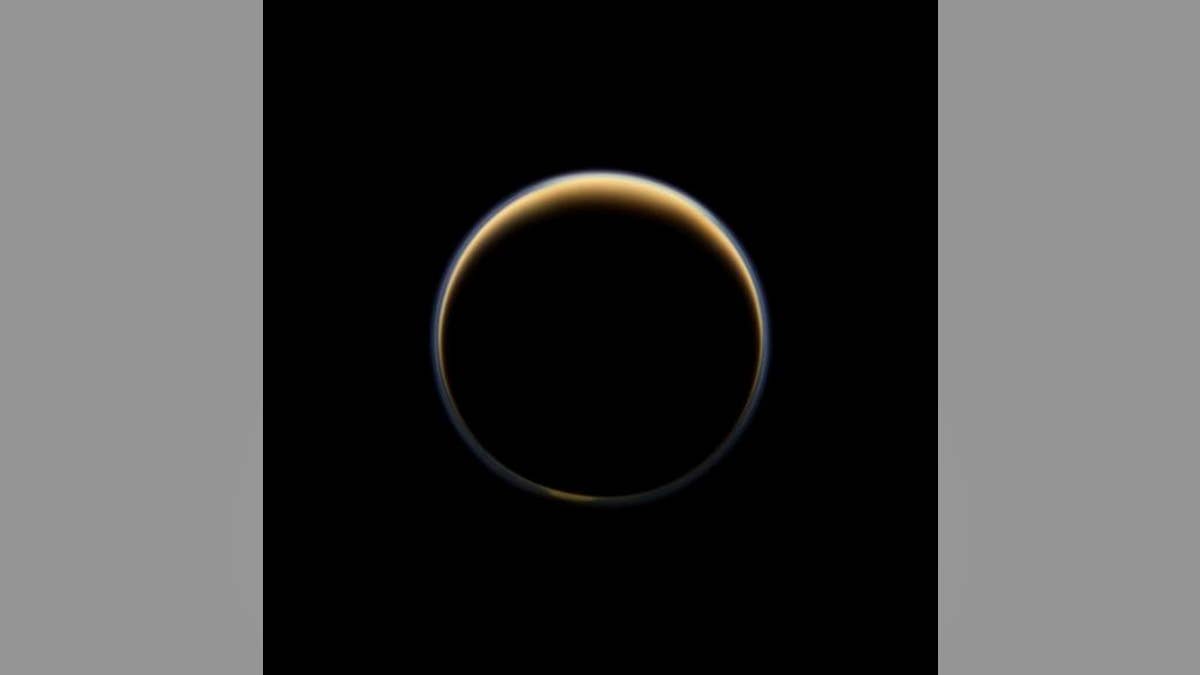
Saturn's moon Titan's atmosphere creates a ring of light outlining the large moon. Image uploaded on Sept. 30, 2013. (NASA/JPL-Caltech/SSI)
For the first time, a chemical essential for the creation of plastic on Earth has been found in a far-off part of the solar system: Saturn's largest Titan.
The discovery, made by NASA's Cassini spacecraft currently orbiting Saturn, found that the atmosphere of Titan contains propylene, a key ingredient of plastic containers, car bumpers and other everyday items on Earth. NASA scientists announced the discovery with a video describing the propylene find on Titan.
"This chemical is all around us in everyday life, strung together in long chains to form a plastic called polypropylene," Conor Nixon, a NASA planetary scientist and lead author of a paper detailing the new research in the Sept. 30 issue of the Astrophysical Journal Letters said in a statement. "That plastic container at the grocery store with the recycling code 5 on the bottom — that's polypropylene." [Amazing Photos: Titan, Saturn's Largest Moon]
[pullquote]
Scientists used Cassini's composite infrared spectrometer (CIRS) instrument, which measures infrared light given off by Saturn and its moon, made the discovery.
The new study helps piece together a long-standing mystery about Titan's atmosphere. When Voyager 1 conducted the first close flyby of the moon in 1980, it recognized gasses in the moon's brown atmosphere as hydrocarbons.
Scientists have found that hydrocarbons — which make up fossil fuels on Earth — form on Titan after sunlight breaks apart methane and the chemicals reform into chains of two or more carbons. Voyager found evidence of the heaviest three-carbon hydrocarbon, propane, and the spacecraft also discovered propyne — one of the lightest in the family.
The middle-weight chemicals like propylene, however, were missing from the Voyager data.
"This measurement was very difficult to make because propylene's weak signature is crowded by related chemicals with much stronger signals," Michael Flasar, Goddard scientist and principal investigator for the CIRS instrument, said in a statement. "This success boosts our confidence that we will find still more chemicals long hidden in Titan's atmosphere."
Titan is about half the size of Earth and is the second-largest moon in the solar system — only Jupiter's Ganymede beats it out in size. The moon is also the only one in the solar system that harbors clouds and a planet-like atmosphere, which is mostly composed of nitrogen and methane.
Cassini launched to space in 1997, arriving in orbit around Saturn in July 2004. The mission — centered on understanding Saturn and its many moons — is expected to continue until 2017 when the spacecraft will be crashed into Saturn's atmosphere.
https://www.foxnews.com/science/nasa-finds-plastic-ingredient-on-saturns-moon-titan