 Print
Print
 Close
Close

Physicists are trying to create the perfect snowflake
By , , Tia Ghose, Associate Editor
Published December 28, 2017
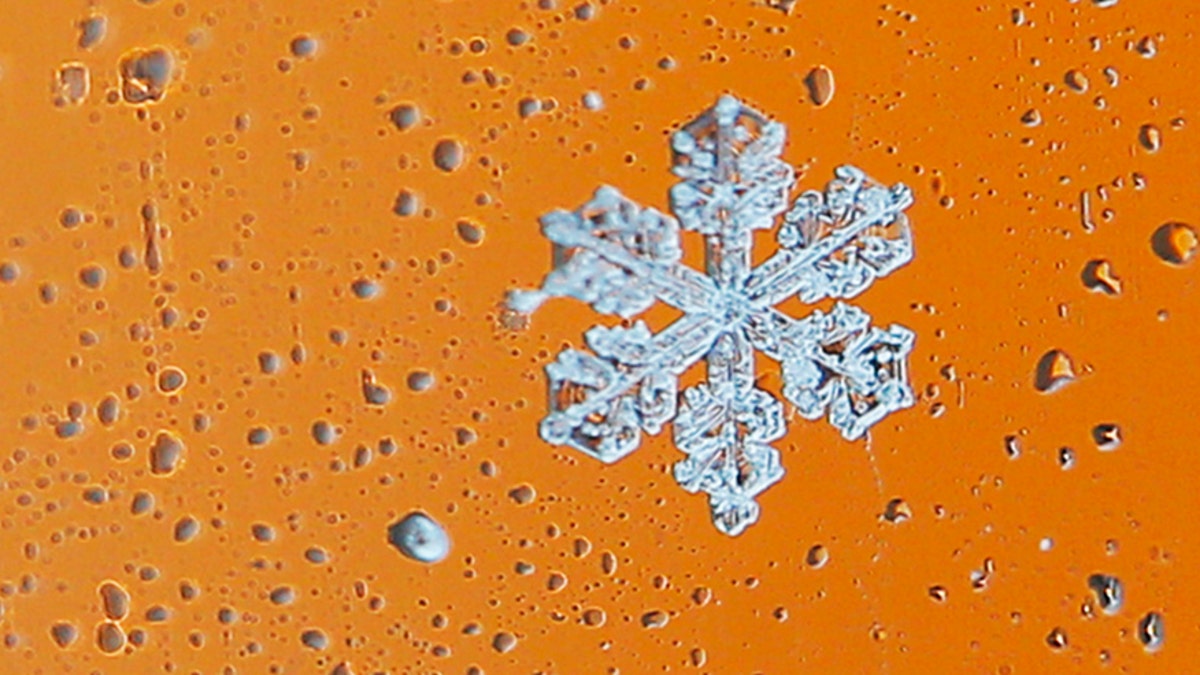
Snowflakes collect on a car window during a winter nor'easter snow storm in Waltham, Massachusetts January 2, 2014. REUTERS/Brian Snyder (UNITED STATES - Tags: ENVIRONMENT TPX IMAGES OF THE DAY) - RTX17080
Nothing in nature is perfect — but frosty, shimmery snowflakes come pretty close.
Now one man is trying to push the limits of those shimmery, symmetrical ice crystals, to make the largest, most perfectly symmetrical snowflake ever, according to the San Jose Mercury News. Libbrecht said he was inspired by snowflakes he encountered in his hometown of Fargo, North Dakota.
Kenneth Libbrecht, a physicist at the California Institute of Technology, in Pasadena, has spent years trying to create such symmetrical beauties in his lab. By carefully controlling the conditions, using commercial recirculating chillers and temperature controllers, he has managed to create 0.5 inch -across snowflakes that retain their pristine symmetry.
But that isn't big enough for him: Libbrecht believes he can make symmetrical crystals as big as 1 inch across or more, the Mercury News reported. There are no physical laws that prevent the formation of arbitrarily large snowflakes, but just a slight change in the environmental conditions can make flakes turn out wonky, Libbrecht said.
"It's easy to grow an ugly snowflake," Libbrecht told The Mercury News. "More things go wrong as they get bigger."
That said, in 2006, NASA scientists measured snowflakes in Ontario, Canada and found that individual snow crystals of about 0.6 inches are not unusual. And not all of them were ugly.
Outside the lab, snow forms high in the atmosphere when crystals form on particles of dirt or dust in the atmosphere. As the burgeoning crystal falls, it encounters an ever-changing set of conditions that continually nudges the snowflake to form in one way or another, which is why no two flakes are alike, the Mercury News reported.
Originally published on Live Science.
https://www.foxnews.com/science/physicists-are-trying-to-create-the-perfect-snowflake