 Print
Print
 Close
Close

Microsoft HoloLens 2 headset will include an artificial intelligence chip
By , Matthew Humphries
Published September 27, 2017
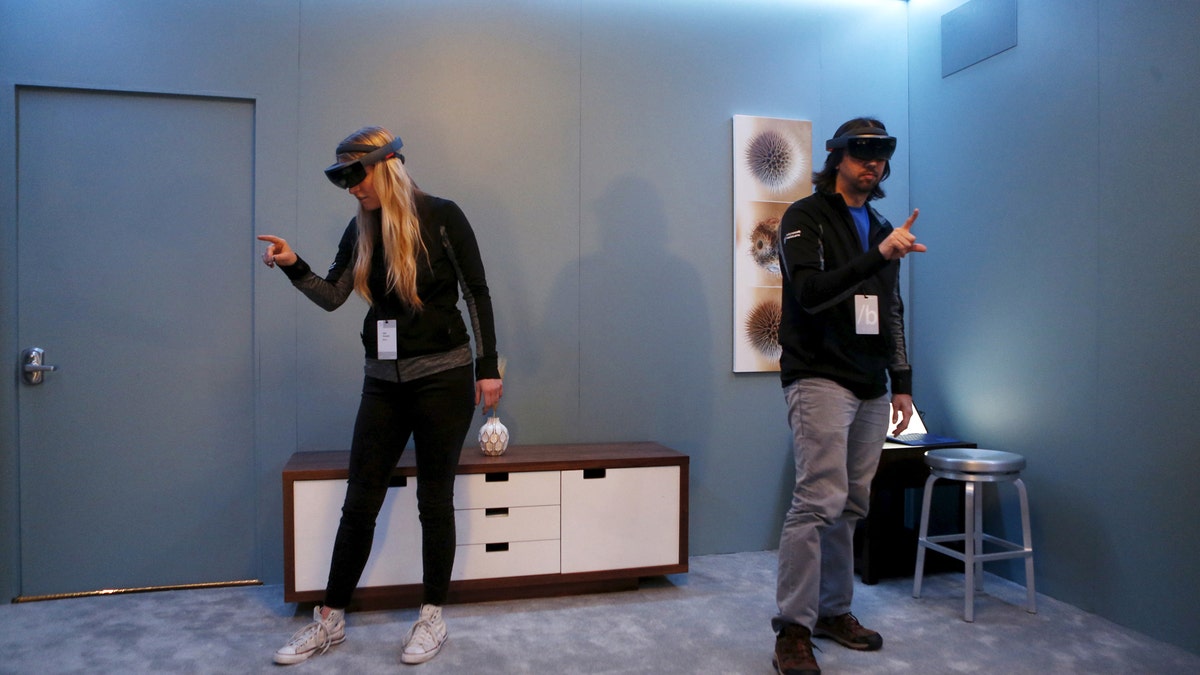
File photo: Microsoft employees demonstrate HoloLens during the Microsoft Build 2016 Developers Conference in San Francisco, California March 30, 2016. (REUTERS/Beck Diefenbach)
There's a lot of focus right now on the future of virtual reality headsets, the cost of entry, and just how good our VR experiences could get. But Microsoft is following a different path, and instead is focusing on mixed reality and holographic headsets. That's how we got HoloLens, and why Microsoft is now starting to talk about HoloLens 2.
Microsoft Research is hard at work developing HoloLens 2, which will continue to be the "world's first–and still only–fully self-contained holographic computer." The self-contained nature of HoloLens means it needs to run on the battery Microsoft incorporates into the headset, so efficiency is key.
To improve HoloLens 2's capabilities while retaining that efficiency, Microsoft decided it needed to design its own artificial intelligence chip. This AI coprocessor will form part of the next custom multiprocessor that powers HoloLens called the Holographic Processing Unit (HPU).
In order for HoloLens to work, it needs to quickly and accurately recognize objects in the world around it. That requires Deep Neural Networks, which right now work best in the cloud running on custom processor/memory architectures. Microsoft's desire to keep HoloLens self-contained means relying on the cloud isn't acceptable, so they are replacing that need with a dedicated AI chip in HPU 2.0.
Moving AI to run locally not only increases efficiency, it also allows for higher performance as there's no need to pull data from the Internet. HoloLens 2 will be able to implement its own DNNs, and developers will have full access to program the AI chip.
For end users, it should mean an obvious improvement in the computer vision capabilities on offer by HoloLens 2, which translates to better experiences.
We have no idea when HoloLens 2 will launch or how much it will cost. The first version only went out to developer in March last year with a consumer version expected at some point this year after preorders opened last October. For now, HoloLens looks like very promising future tech, with the emphasis there definitely on "future."
This article originally appeared on PCMag.com.
https://www.foxnews.com/tech/microsoft-hololens-2-headset-will-include-an-artificial-intelligence-chip