 Print
Print
 Close
Close

Toyota's CUE7 robot shoots hoops using AI
By Kurt Knutsson, CyberGuy Report
Published April 23, 2026

Most people think of Toyota and picture a Camry, a Tacoma, maybe a Prius. A 7-foot-2 robot shooting free throws at halftime of a professional basketball game? That's a harder image to conjure. But recently, that's exactly what happened at Toyota Arena Tokyo, and around 8,400 fans watched it go down live.
The robot is called the CUE7. It smoothly stood up from a seated position, dribbled a basketball and sank a free throw without any human input. The crowd applauded. The engineers probably exhaled. Toyota had officially debuted its most advanced AI-powered humanoid robot, and it chose basketball as the venue.
So why is a car company building basketball robots? And what does any of this have to do with you? More than you might think.
Sign up for my FREE CyberGuy Report
- Get my best tech tips, urgent security alerts and exclusive deals delivered straight to your inbox.
- For simple, real-world ways to spot scams early and stay protected, visit CyberGuy.com – trusted by millions who watch CyberGuy on TV daily.
- Plus, you'll get instant access to my Ultimate Scam Survival Guide free when you join.
AI-POWERED ROBOT SINKS SEEMINGLY IMPOSSIBLE BASKETBALL HOOPS
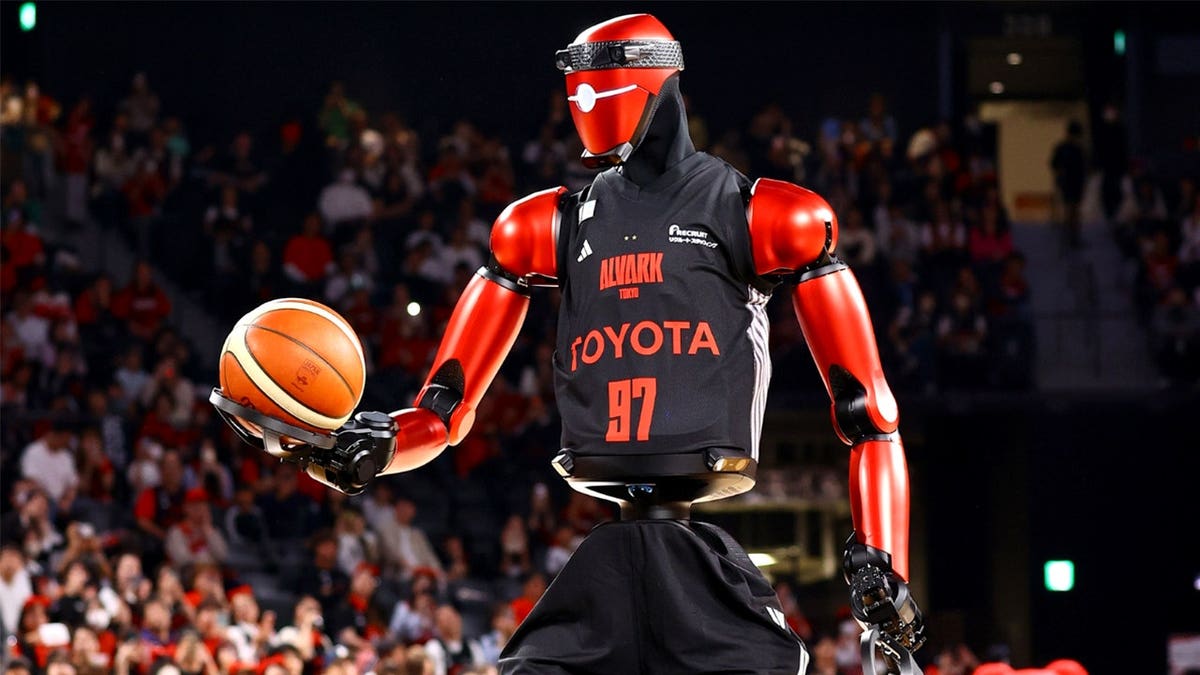
Toyota’s CUE7 robot handles the ball with precision, showing how AI can learn complex physical movement. (Toyota Motor Corporation)
The CUE7 started from scratch, on purpose
Here's the thing that makes the CUE7 genuinely different from its predecessors: Toyota's team discarded everything they had built and started over.
"We made full use of AI, and we discarded everything we had built up and started again from scratch," said Tomohiro Nomi, research leader for humanoid robots at Toyota's Frontier Research Center.
That's not a small statement. The CUE series goes back to 2017, when a group of Toyota employees launched it as a voluntary side project on their own time. It eventually became an official research program, and over nearly a decade, the team stacked up some genuinely impressive hardware. The CUE3 earned a Guinness World Record in 2019 for most consecutive basketball free throws by a humanoid robot (assisted), sinking 2,020 in a row. Then the CUE6 earned the record for the farthest basketball shot by a robot, connecting from about 80 feet 6 inches) away.
So the legacy was already there. What changed with CUE7 was the philosophy behind how it learns.
From human programming to AI that figures it out alone
Earlier versions of the CUE relied on something called model predictive control. Basically, human engineers programmed exactly how the robot should move, step by step. It worked well enough to break world records. But it also had a ceiling. Every new motion required new programming by a human being.
The CUE7 instead uses reinforcement learning powered by artificial intelligence. It learns to shoot the ball based on its own experience and trial and error rather than pre-programmed instructions. The AI acts as an autonomous agent: it tries something, observes the result, adjusts and tries again. Over enough repetitions, it gets good. Really good.
The hybrid control system merges reinforcement learning with model predictive control, creating a robot that adapts to unexpected situations rather than just following a fixed script. Think of it as the difference between a player who memorized every play in the book and one who reads the game in real time. CUE7 is learning to read the game.
What's actually inside the CUE7 robot
The CUE7 stands about 7 feet 2 inches tall and weighs roughly 163 pounds, making it about 40% lighter than the previous version, which came in around 265 pounds. Toyota pulled that off by simplifying the structure and reducing the number of axles.
It also switched from four wheels to two, which makes its movement faster and more fluid. One moment that really stood out was how smoothly it can rise from a seated position. That kind of motion, especially at this size, takes serious engineering and drew a reaction from a crowd of more than 8,000 people.
For sensing and aiming, the robot uses lidar sensors in its torso to detect its surroundings, along with a stereo camera in its head to calculate distance and angle. It is powered by high-performance batteries adapted from Toyota's racing tech.
Here's where it gets interesting. The robot measures the distance to the hoop, calculates the angle, determines the right trajectory and then releases the shot with controlled force. If it misses, it learns from that attempt and adjusts on the next one.
ROBOT PLAYS TENNIS WITH HUMANS IN REAL TIME
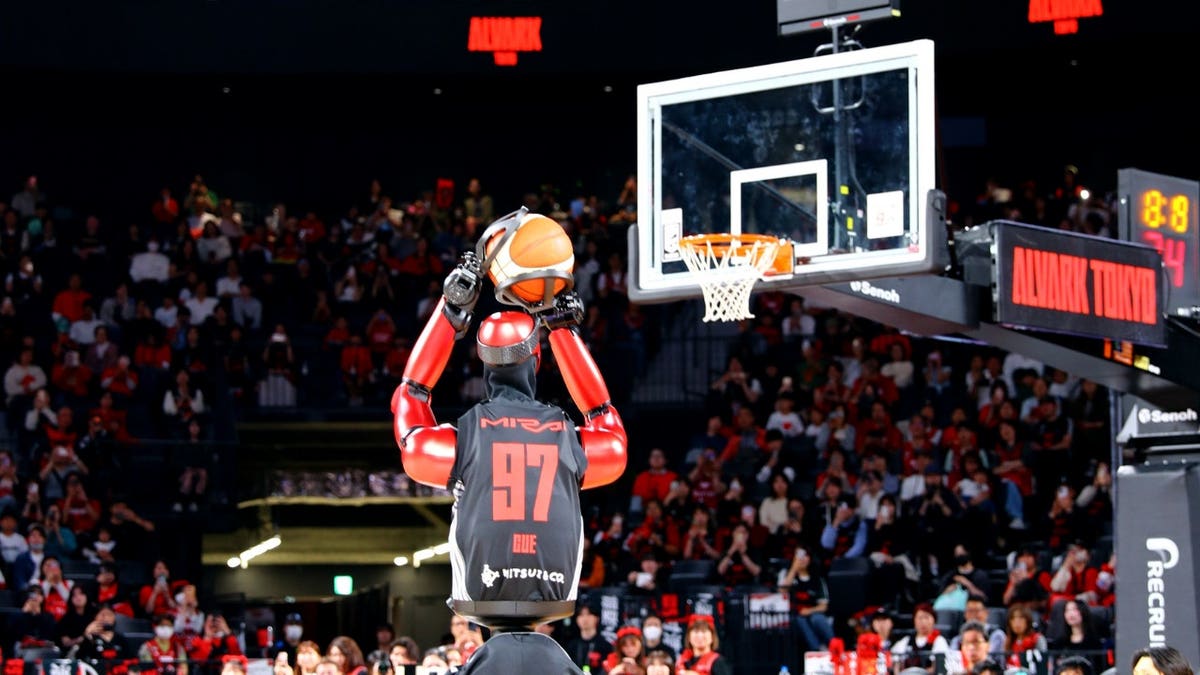
During a live game demo, the robot lines up a shot, highlighting how machines can adapt in real-world environments. (Toyota Motor Corporation)
The AI that actually makes this work
Toyota trained the system using human motion data, which is what gives CUE7 its surprisingly natural movement. Rather than looking mechanical, its actions mirror how a person actually moves, and that's by design.
That same combination of real-time calculation and learned experience is what lets it handle something like dribbling (fluid, continuous) alongside shooting (precise, calculated) without the two working against each other.
Toyota says testing that kind of learning in a live environment is a key part of the project.
"We believe it is an exceptionally valuable opportunity to validate a reinforcement-learning-based robot in the inherently uncertain environment of a basketball arena," Tomohiro Nomi, Head of Humanoid Robotics Research Unit, Frontier Research Center, Toyota Motor Corporation, told CyberGuy. "Moving forward, we will continue developing robots that inspire and bring joy to people."
What this means to you
You're probably not buying a robot basketball player anytime soon. But here's the part worth paying attention to: the same AI that helps CUE7 sink free throws is the technology Toyota is actively developing for manufacturing, automotive systems and real-world robotics.
Basketball demands everything that manufacturing robots struggle with: target identification, distance gauging, trajectory computation, coordinated movement and precise force control, all in sequence and under pressure. Toyota chose basketball specifically because it tests all those capabilities at once, in an environment where success and failure are completely obvious.
The reinforcement learning powering CUE7 could eventually show up in factory robots that adapt mid-shift when production requirements change, in vehicles that handle unexpected road conditions more fluidly, or in home and care robots that need to navigate unpredictable environments. Toyota treats CUE7 as a testbed for vision systems, motion control and coordinated movement, with capabilities that reach well beyond halftime demonstrations into broader real-world applications.
When Toyota teaches a robot to play basketball, it's really teaching machines how to learn. And that skill transfers. In other words, this is less about basketball and more about teaching machines how to learn physical skills in unpredictable environments. That is where the real impact starts to show up.
THE NEW ROBOT THAT COULD MAKE CHORES A THING OF THE PAST
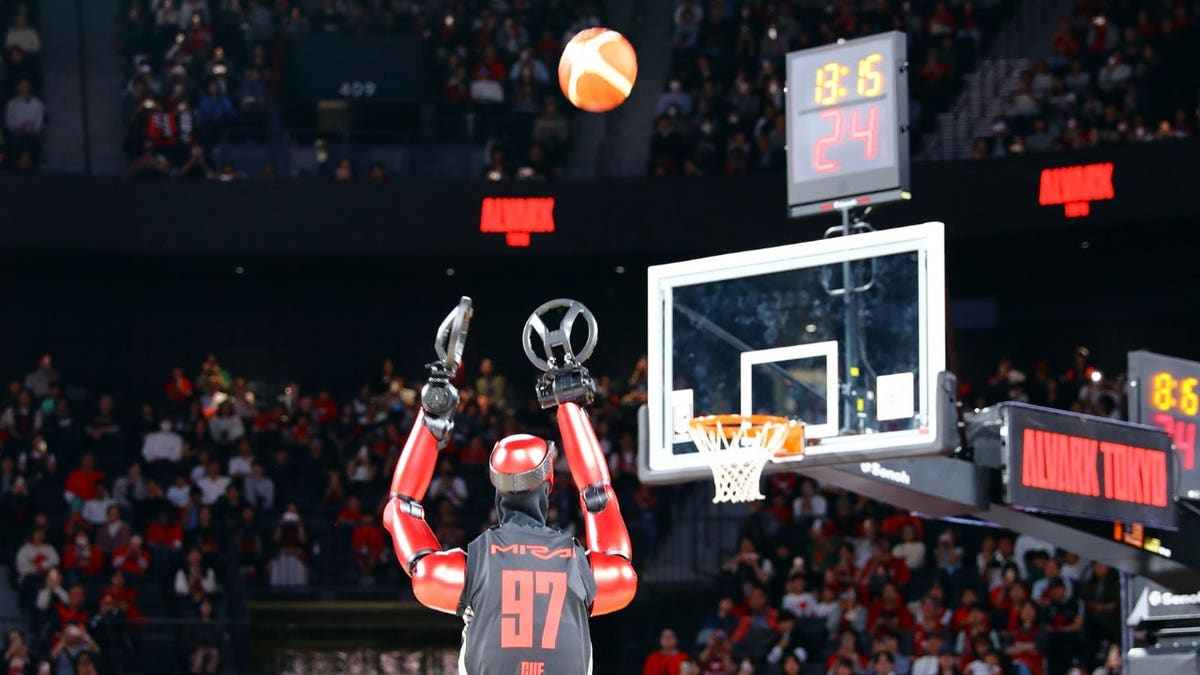
CUE7 sinks a free throw, a simple moment that reflects a bigger shift toward AI that learns through experience. (Toyota Motor Corporation)
Take my quiz: How safe is your online security?
Think your devices and data are truly protected? Take this quick quiz to see where your digital habits stand. From passwords to Wi-Fi settings, you’ll get a personalized breakdown of what you’re doing right and what needs improvement. Take my Quiz here: Cyberguy.com.
Kurt's key takeaways
The CUE7 is a fascinating piece of technology, but the real story isn't about basketball. It's about a fundamental shift in how robots are trained, moving away from rigid human programming toward AI systems that learn through experience and adapt on the fly. What started as a voluntary employee side project in 2017 has grown into a genuine proving ground for Toyota's embodied AI research. Nearly a decade in, the results are landing in front of thousands of live spectators and stacking up Guinness World Records along the way. The CUE7 made a free throw at halftime in front of a packed arena. More importantly, it demonstrated that AI-powered machines can now acquire complex physical skills through trial and error, the same basic way humans do. That's a shift with implications that reach far beyond the basketball court.
If a robot can teach itself to make free throws better than most humans ever will, purely through AI-driven trial and error, what physical skill do you still believe machines will never be able to learn on their own? Let us know by writing to us at Cyberguy.com.
CLICK HERE TO DOWNLOAD THE FOX NEWS APP
Sign up for my FREE CyberGuy Report
- Get my best tech tips, urgent security alerts and exclusive deals delivered straight to your inbox.
- For simple, real-world ways to spot scams early and stay protected, visit CyberGuy.com – trusted by millions who watch CyberGuy on TV daily.
- Plus, you'll get instant access to my Ultimate Scam Survival Guide free when you join.
Copyright 2026 CyberGuy.com. All rights reserved.
https://www.foxnews.com/tech/toyota-cue7-robot-shoots-hoops-using-ai