
Reactions pour in to Virginia approving gerrymandered districts favoring Democrats
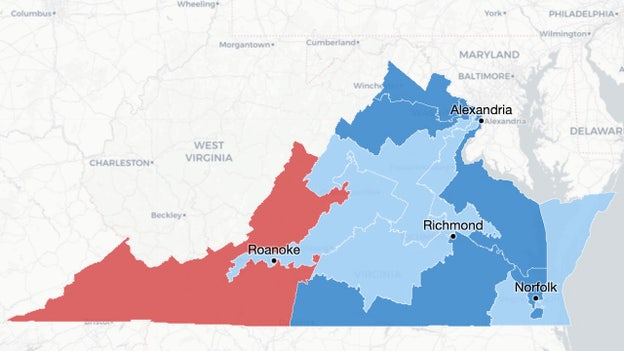
Virginia narrowly passed a special ballot resolution to quickly redraw its voting district maps to turn a 6-5 Republican U.S. House delegation into a potential 10-1 Democrat edge in the upcoming midterm elections this November. Republicans say there is a constitutional challenge to the timing and structure of the ballot question that passed, vowing to appeal.
Coverage for this event has ended.
Trump: Va ballot 'referendum was purposefully unintelligible and deceptive'
President Donald Trump blasted Virginia’s ballot measure Wednesday, calling the referendum language “purposefully unintelligible and deceptive.”
"The Democrats eked out another Crooked Victory!" Trump wrote Wednesday on Truth Social. "Six to five goes to ten to one, and yet the Presidential Election in November was very close to a 50-50 split.
"In addition to everything else, the language on the Referendum was purposefully unintelligible and deceptive.
"As everyone knows, I am an extraordinarily brilliant person, and even I had no idea what the hell they were talking about in the Referendum, and neither do they!
"Let’s see if the Courts will fix this travesty of 'Justice.'"
Karoline Leavitt points to Trump’s busy schedule after questions on Virginia referendum
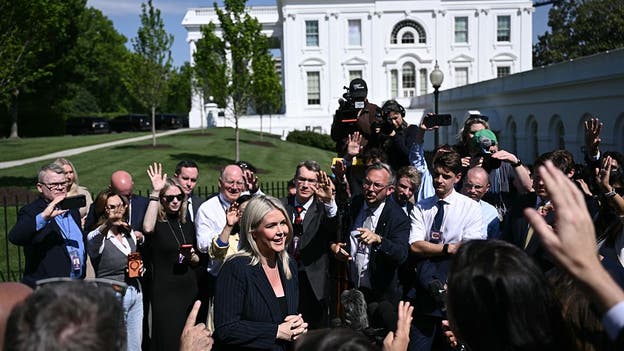
White House press secretary Karoline Leavitt said President Donald Trump "has a lot on his plate" when asked why he did not play a more active role in opposing Virginia’s redistricting referendum.
During a gaggle on Wednesday, a reporter asked Leavitt about Trump’s involvement in the ballot measure, which passed Tuesday, and why he did not spend more time urging voters to oppose it.
"That’s a question that’s political by nature. As you know, I’m not part of the president’s political team anymore," Leavitt replied. "I do sit here at the White House as a government employee."
"Look, the president has a lot on his plate, a lot on his schedule. He did host a telephone call the night before the election. But he’s made his position on the result of this election," she added.
Spanberger calls for ‘better representation’ following Virginia vote
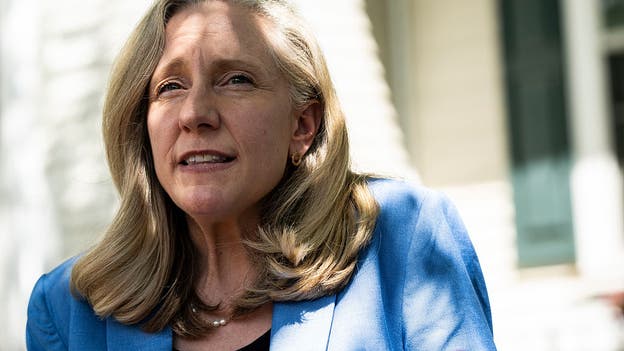
Virginia Gov. Abigail Spanberger responded to Republican criticism of the state’s redistricting ballot measure that passed Tuesday, arguing the broader issue is how lawmakers represent their constituents.
"The construct where we accept this notion that there are Democratic representatives who just represent Democrats and Republican representatives who just represent Republicans is at the heart of the problems facing the United States Congress," she said Wednesday.
Spanberger also pushed back on claims the new map would leave some voters without representation, pointing to her own 2018 win in a Republican-leaning district.
"I won by 2 points, but my predecessor had won by 15," she said of Virginia’s 7th District.
AOC praises Jeffries 'energy' for 'maximum warfare, everywhere' on redistricting
Rep. Alexandria Ocasio-Cortez, D-N.Y., threw her support behind House Minority Leader Hakeem Jeffries’ hardline redistricting message Wednesday, praising his call for “maximum warfare, everywhere” with a short but emphatic social media post.
“Hell yes. This is the energy,” Ocasio-Cortez wrote on X.
The post came after Jeffries vowed an aggressive Democrat response if Florida Republicans move ahead with a new congressional map in next week’s special session.
Jeffries warned that Democrats are ready for “maximum warfare, everywhere, all the time” as the redistricting fight escalates.
House Dem Leader Jeffries vows 'maximum warfare' on redistricting
House Minority Leader Hakeem Jeffries, D-N.Y., is escalating the redistricting war, warning Florida Republicans they will face “maximum warfare” if GOP Gov. Ron DeSantis and the Legislature move ahead with a new congressional map during next week’s special session.
Jeffries blasted the expected Florida redraw as an “illegal scheme” and vowed Democrats would go on offense against a slate of Republican incumbents if the plan moves forward.
“If Florida Republicans proceed with this illegal scheme, they will only create more prime pick-up opportunities for Democrats, just as they did with Trump’s dummymander in Texas,” Jeffries said. “We will aggressively target for defeat Mario Díaz-Balart, Maria Elvira Salazar, Carlos Giménez, Kat Cammack, Anna Paulina Luna, Laurel Lee, Cory Mills and Brian Mast.
"We are prepared to take them all on, and we are prepared to win.”
Jeffries drove the message home with a blunt warning: “Maximum warfare, everywhere, all the time.”
Rep. Alexandria Ocasio-Cortez, D-N.Y., cheered his posture, writing: “Hell yes. This is the energy.”
The threat comes as both parties intensify a national redistricting fight with control of the House on the line. Florida’s special session on congressional redistricting is set for April 28, though DeSantis has not yet released a proposed map.
Trump political advisor says Virginia outcome points to ‘historic midterm’ for GOP
White House midterm strategist James Blair said Wednesday that he expects the Virginia Supreme Court to ultimately find the state’s newly approved redistricting move unlawful, arguing the legal fight is far from over even after Tuesday’s vote.
Blair framed the outcome as less of a Democrat triumph than an actual warning sign ahead for a "historic midterm" — and as a case still headed for court.
“This is illegal what they did under their own state law," Blair said in a CNN interview Wednesday. "A lower court judge already said that. And the Supreme Court let the referendum go on, but they still have to rule on the merits.
"And if they do the right thing, they will rule that this was an illegal action for this cycle.
Democrats’ margin in Virginia was narrower than expected in a state, Blair noted, that had backed Democrats by much larger margins in recent statewide races.
“Last night, this was a 3-point race,” he said, adding that if Republicans perform similarly in 2026, “we not only add seats to the Senate, but we add seats to the House, and we have a historic midterm.”
Blair also pushed back on criticism that Republicans were badly outspent, saying while Democrats “unloaded $60, $70 million, whatever it was" the results in several redrawn districts “should concern” Democrats, arguing the new lines are “not slam dunk districts for them.”
NRCC chair defends GOP's Virginia spending strategy after narrow loss
National Congressional Committee (NRCC) Chair Richard Hudson, R-N.C., defended Republicans’ Virginia strategy Wednesday morning, pushing back on criticism that the GOP did not spend enough in the high-profile fight and arguing the battle is still headed for the courts.
“I don’t think this is over,” Hudson, R-N.C., told reporters at the Capitol. “I mean, I think last night was an embarrassment from the Supreme Left that’s governing Virginia. They said Virginia is a 10-1 state and half the state voted no last night.”
When asked about complaints from Republicans that more money could have helped them win, Hudson dismissed the criticism.
“That’s coming from people who aren’t aware of what was spent,” he said.
A narrow loss potentially helps prove a legal case, according to Hudson, and the courts are still expected to weigh in to overrule the electorate in Virginia State Supreme Court.
The court blocking the map might ultimately render Democrat spending (with estimates from $64 million to as much as $70 million) potentially wasted.
“Our team collectively made significant investments and we won half the vote and the courts now need to uphold the lower court ruling that this is a clear violation of the Constitution. It’s illegal,” Hudson said, adding that the “speaker and I engaged in this from the very beginning” and Republicans were working “within the limits of what we’re allowed to coordinate.”
"Everybody was in and everybody did what they needed to do,” he added.
He also argued the result showed significant resistance to the measure, saying opponents “were able to get 51% of the vote in the state that Trump lost by 5.8 and [Virginia Democrat Gov.] Spanberger won by 15 points.”
“The people of Virginia outside of Fairfax and three other counties voted no last night," he concluded, with the caveat that the state Supreme Court might ultimately have the final "no" vote coming on the basis of the law.
GOP calls out 'misleading language' in Va ballot question, might be basis for legal challenge
Democrats' own bold language on the Virginia ballot measure narrowly approved by voters Tuesday night might ultimately lead to its own demise, according to Republicans.
Republicans and opponents of the state’s redistricting referendum are arguing voters were misled by the language they were asked to approve.
The question: "Should the Constitution of Virginia be amended to allow the General Assembly to temporarily adopt new congressional districts to restore fairness in the upcoming elections, while ensuring Virginia's standard redistricting process resumes for all future redistricting after the 2030 census?"
GOP leaders and anti-referendum advocates pointed to what they called “misleading” and even “dishonest” ballot wording as a possible basis for continued legal action.
That gives opponents a clear post-election lane: challenge not just the politics of the maps, but the fairness and legality of the referendum process itself.
“This close margin reinforces that Virginia is a purple state that shouldn’t be represented by a severe partisan gerrymander,” NRCC Chairman Richard Hudson, R-N.C., said in a statement.
Hudson said Virginia Democrats “can’t redraw reality” and argued the courts should continue to block what he and former Virginia GOP Gov. Glenn Youngkin called an “egregious power grab.”
House Minority Leader Terry Kilgore, R-Scott, said the vote result was disappointing but "not surprising," because it was rigged, he argued.
“From the start, this process was tilted: misleading ballot language and a massive spending advantage made this an uphill climb for voters trying to make sense of a deeply complicated issue,” Kilgore said.
“But the ballot box was never the final word here,” Kilgore said. “Serious legal questions remain about both the wording of this referendum and the process used to put it before voters.”
“Those questions have not been resolved, and they now move where they belong: to the courts.” he added.
Former Virginia House GOP Majority Leader Eric Cantor also blasted the referendum wording.
“Today, Virginians cast their votes to preserve their voices in Congress while going up against $70 million of out-of-state money and shamefully misleading ballot language intended to keep them silent,” Cantor said. “Evidently, a sufficient number of Virginians trusted the blatantly dishonest language the Democrats placed on the ballot,” he added.
Virginians for Fair Maps, the group opposing the referendum, struck the same note in a statement posted after the vote.
“Today’s outcome means the fight resumes in the courts,” the group’s co-chairs, former Attorney General Jason Miyares and Cantor, said in a joint statement.
They argued Virginians have a right to vote on constitutional amendments only if those questions are placed before them through a fair process, citing Coleman v. Pross.
The legal theory now taking shape is straightforward: if the ballot language was materially misleading, opponents could argue the referendum result itself should not be the final word.
That does not guarantee a court win, but in a close vote, Republicans are plainly betting the language issue gives them their strongest path forward.
“Tonight marks the end of the campaign," Kilgore concluded. "It does not mark the end of this fight.”
Virginia Supreme Court could still overrule Tuesday's gerrymander vote result
The Virginia redistricting fight is not over after Tuesday’s referendum.
While the Virginia Supreme Court allowed the ballot vote to proceed amid legal challenges, the justices have yet to weigh in on the underlying legal merits of the referendum itself — meaning the legal battle is still very much alive.
"Virginia Democrats can’t redraw reality: This close margin reinforces that Virginia is a purple state that shouldn’t be represented by a severe partisan gerrymander," National Republican Congressional Committee Chair Richard Hudson wrote in a statement after the results posted Tuesday night.
"That’s exactly why the courts, who have already ruled twice to block this egregious power grab, should uphold Virginia law.
"Even under this map, Republicans will hold our majority based on our record cleaning up Democrats’ mess and a historic war chest to litigate the Democrats’ failures."
Virginia House Minority Leader Terry Kilgore, R-Scott, echoed that the referendum was only one stage of the fight, not the conclusion.
"The ballot box was never the final word here," he wrote in a statement. "Serious legal questions remain about both the wording of this referendum and the process used to put it before voters.
"Those questions have not been resolved, and they now move where they belong: to the courts.
"Tonight marks the end of the campaign. It does not mark the end of this fight. We will continue to stand for fair maps, transparent process, and equal representation for every Virginian.”
GOP questions Va funding: 'Massive spending advantage made this an uphill climb'
Democrats poured a reported $64 million in in "dark money" into the Virginia gerrymandering referendum, compared to about just $20 million from the GOP, leaving Republicans questioning why more of the war chest was not deployed.
Virginia House Minority Leader Terry Kilgore, R-Scott, argued that the narrow redistricting referendum loss as a fight shaped as much by process and money as by the final vote.
"While these weren’t the results we were hoping for, they were not unexpected," Kilgore said in a statement. "From the start, this process was tilted: misleading ballot language and a massive spending advantage made this an uphill climb for voters trying to make sense of a deeply complicated issue."
He added that Republicans still see unresolved legal questions over both the wording of the referendum and the process used to place it on the ballot, and said the battle now shifts to the courts.
Kilgore’s statement comes as national and state Republicans, in the wake of the loss, are increasingly pointing inward.
According to Politico, multiple GOP operatives and strategists argued the party failed to invest early or heavily enough in Virginia, where Democrats held roughly a 3-1 spending advantage.
That gap left Republicans outgunned on the airwaves for much of the campaign and has fueled fresh frustration over whether the party missed a chance to stop a map that could net Democrats as many as four House seats.
"They have outspent us three to one. They’ve raised over $70 million. And yet this is a close vote," former Virginia Gov. Glenn Youngkin, one of leaders of the GOP effort to defeat the referendum, told Fox News Digital on the eve of the election.
Fox News' Paul Steinhauser contributed to this report.
New Virginia map may flip House from GOP to Dems this November
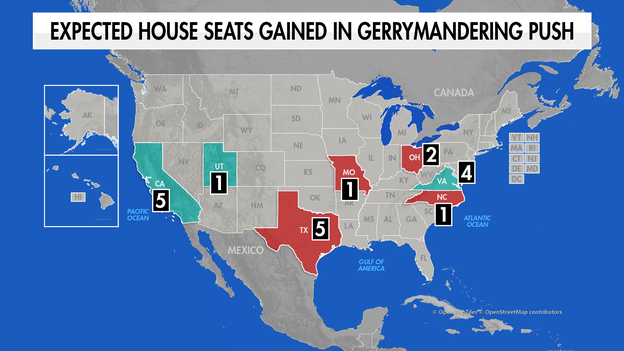
Virginia’s new map is not just a state-level political victory. It also puts Democrats slightly ahead in the national redistricting battle.
According to Politico, if every newly redrawn map performs as projected, Democrats would come out of the gerrymandering fight with a narrow net gain of one seat nationwide.
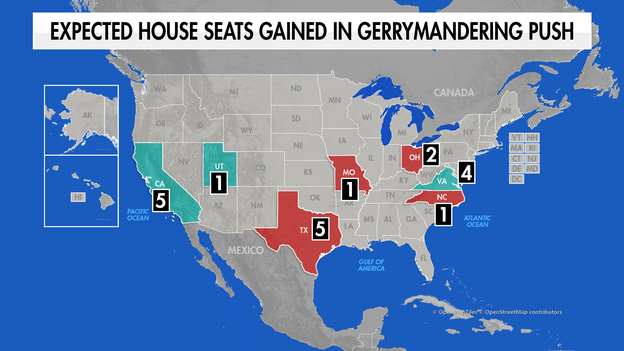
Republicans have so far been positioned to gain nine seats overall — five in Texas, two in Ohio, one in North Carolina and one in Missouri.
Democrats, meanwhile, are projected to gain 10 seats: five in California, four in Virginia and one in Utah, where the map was redrawn by the courts.
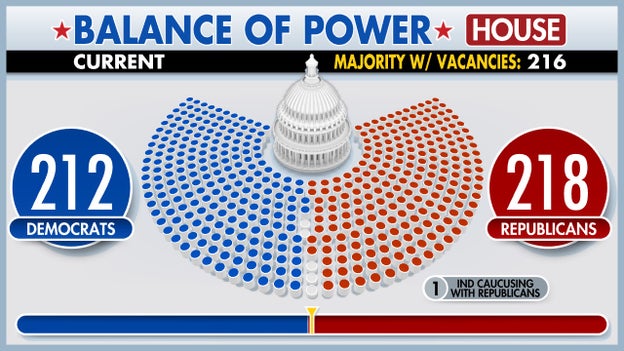
That means the current 218-213 House GOP majority will not only tighten but potentially flip blue. That current majority number includes one California independent who left the Republican Party and four vacancies:
Rep. Doug LaMalfa, R-Calif., died Jan. 6 and still not filled in the largest blue state.
Rep. Eric Swalwell, D-Calif., resigned April 14.
Rep. Tony Gonzales, R-Texas, resigned April 14.
Rep. Sheila Cherfilus-McCormick, D-Fla., resigned Tuesday.
There could be a vote related to possible expelling Rep. Cory Mills, R-Fla., on Wednesday.
Those special elections are still to come for temporary hold on seats until their own reelection comes in November.
Fox News' Chad Pergram contributed to this report.
GOP operative calls on Florida to respond to Virginia redistricting: Make it 'redder'
Republicans are proverbially red faced and urging Florida to take out the red marker and paint the state "redder."
"To my friends in Tallahassee: in a state that is ruby red, it’s time to respond to what we saw tonight in Virginia with a redistricting plan that reflects Florida’s true partisan lean—and adds 3–4 GOP seats to our supermajority," former White House spokesman Harrison Fields, a former staffer for Florida GOP gubernatorial candidate Rep. Byron Donalds, R-Fla., wrote on X.
"Virginia is a purple state being drawn as deep blue. Florida should draw a map that’s even redder—and get it passed ASAP. Cc: @GovRonDeSantis @Daniel_PerezFL @FLSenate"
Obama blasted for praising Virginia gerrymander as boost for ‘democracy’

Social media was not having any of former President Barack Obama's political posturing.
Obama is getting blasted Wednesday after celebrating Virginia voters’ approval of a redistricting measure that could heavily benefit Democrats in the state’s House delegation.
In a post on X, Obama congratulated Virginia and said the vote showed what it looks like to “stand up for our democracy and fight back.”
Critics quickly accused Obama of endorsing partisan gerrymandering.
The approved plan is expected to shift Virginia’s current 6-5 Democrat edge in the U.S. House delegation to a potential 10-1 Democrat advantage, fueling conservative claims that the new map is less about fairness than raw political power.
Former DHS spokeswoman Tricia McLaughlin called the Obama's claims "a farce."
Turning Point USA activist Savannah Hernandez rebuked the political power play.
Former Tennessee basketball coach Bruce Pearl rebuked "restore fairness" claim as patently "unfair."
Former Virginia GOP Gov. Glenn Youngkin joined the pushback, thanking voters who opposed what he called an “egregious power grab” and urging the Virginia Supreme Court to block the process as unconstitutional.
Florida retaliation looms after Virginia redistricting win boosts Democrats’ House hopes
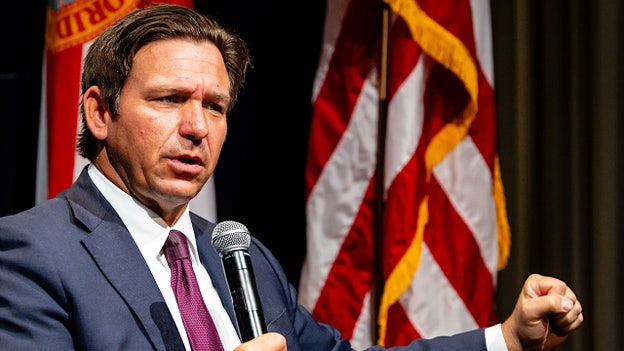
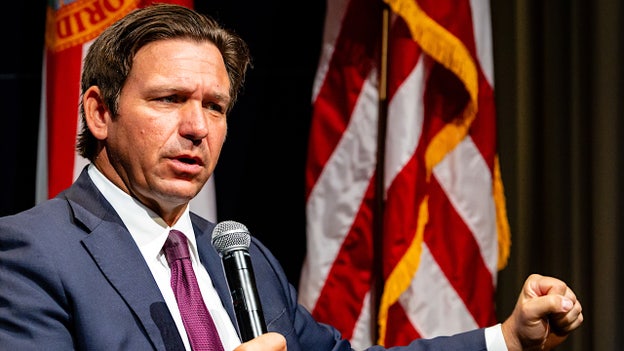
The political football is now in Florida's hands, a former swing state that GOP Gov. Ron DeSantis has boasted making the reliably red, the second largest red state on the map.
Democrats’ narrow victory in Virginia’s redistricting referendum is already escalating the national map fight, with Florida Republicans preparing to consider their own redraw next week in a bid to answer Virginia’s move.
Virginia voters approved a mid-decade redistricting plan Tuesday night that could help Democrats gain as many as four House seats, a shift that would strengthen the party’s chances of flipping control of the chamber in November.
Democrats see Virginia’s new lines as a way to counter Republican gains elsewhere, while the revised map could move the state’s delegation from the current 6-5 Democrat edge to as many as 10 Democrat seats out of 11.
That outcome would have major national implications.
Democrats need only a small number of seat pickups to take control of the 435-member House, and Virginia’s redraw is now central to that strategy. The referendum was also a political boost for Virginia Democrat Gov. Abigail Spanberger, who backed the measure and whose 2025 statewide win had already fueled Democrat optimism heading into the 2026 cycle.
But the redistricting arms race is not over.
In Florida, Gov. Ron DeSantis has already called a special session in April to consider a mid-decade redraw, a move that AP said could help Republicans strengthen their grip on a congressional delegation where they currently hold 20 of 28 seats.
That effort is itself facing a legal challenge, with opponents arguing DeSantis lacks the authority under the Florida Constitution to force lawmakers back to redraw the map.
Virginia’s new map is not fully settled either.
Although voters approved the referendum, the Virginia Supreme Court is still considering whether the process itself was lawful, after lower-court rulings found potential procedural defects in how the amendment reached the ballot. That means the political message from Tuesday’s vote is clear, but the legal fight over whether the redraw ultimately stands is still unresolved.
If Florida Republicans move ahead next week, Virginia might prove less the end of the redistricting fight than the opening shot in its next phase.
Notably Iowa rejected a President Donald Trump call to redraw that states lines to favor the Republican Party.
The Associated Press and Reuters contributed to this report.
Virginia Gov. Glenn Youngkin blasted the state’s newly approved redistricting referendum in an X post, thanking voters who opposed what he called an “egregious power grab” and arguing the close margin showed Virginians do not support a map that could heavily favor Democrats.
The measure passed Tuesday night and will allow Virginia’s General Assembly to temporarily redraw congressional maps ahead of the 2026 midterms, with potentially major implications for control of the U.S. House.
“The race was much closer than the left expected because Virginians know a 10-1 map is not Virginia,” Youngkin wrote, urging the Virginia Supreme Court to strike down what he called an unconstitutional process that would “disenfranchise millions of Virginians.”
His statement sharpens the Republican argument that the referendum’s timing and structure are legally flawed, even after voters approved it.
While Democrats and referendum supporters are framing the result as a voter-approved path to redraw the map, Republicans are increasingly casting it as a constitutional battle that is far from over.
Live Coverage begins here