



















Fox News Flash top headlines for April 7
Fox News Flash top headlines are here. Check out what's clicking on FoxNews.com.
Policymakers have been aware of U.S. vulnerability to China’s supply chain dominance for decades and have contemplated the possibility of Beijing weaponizing its control by throttling exports to the United States. Last summer, Chinese President Xi Jinping did. Relying on an adversary’s good graces on matters of national health and security invites disaster. But critical minerals are only one weakness. Washington also relies on Beijing for the nation’s pharmaceuticals. It should be intolerable.
In 2000, America imported roughly 100,000 metric tons of pharmaceuticals. By 2024, that figure had jumped above 800,000 metric tons. Last year, the United States imported roughly 90% of inputs for prescription drugs. About half of these medicines come from India, but India sources 70% to 80% of active pharmaceutical ingredients (APIs) from China.
America’s medical dependency on the Chinese Communist Party (CCP) does not end there. Chinese companies are now beginning to outpace U.S. competitors in drug discovery, not merely drug production. Consider this warning from the National Security Commission on Emerging Biotechnology: "In just three years, China’s biopharmaceutical industry rose from near irrelevance to dominance."
What does that mean practically? Per the commission’s findings: "This overall innovation trend is set to accelerate, with Chinese drugs projected to account for 35%" of new drug approvals by 2040.
NOT JUST TARIFFS: FOREIGN NATIONS PROFITED OFF OF US — NOW TRUMP IS STRIKING BACK
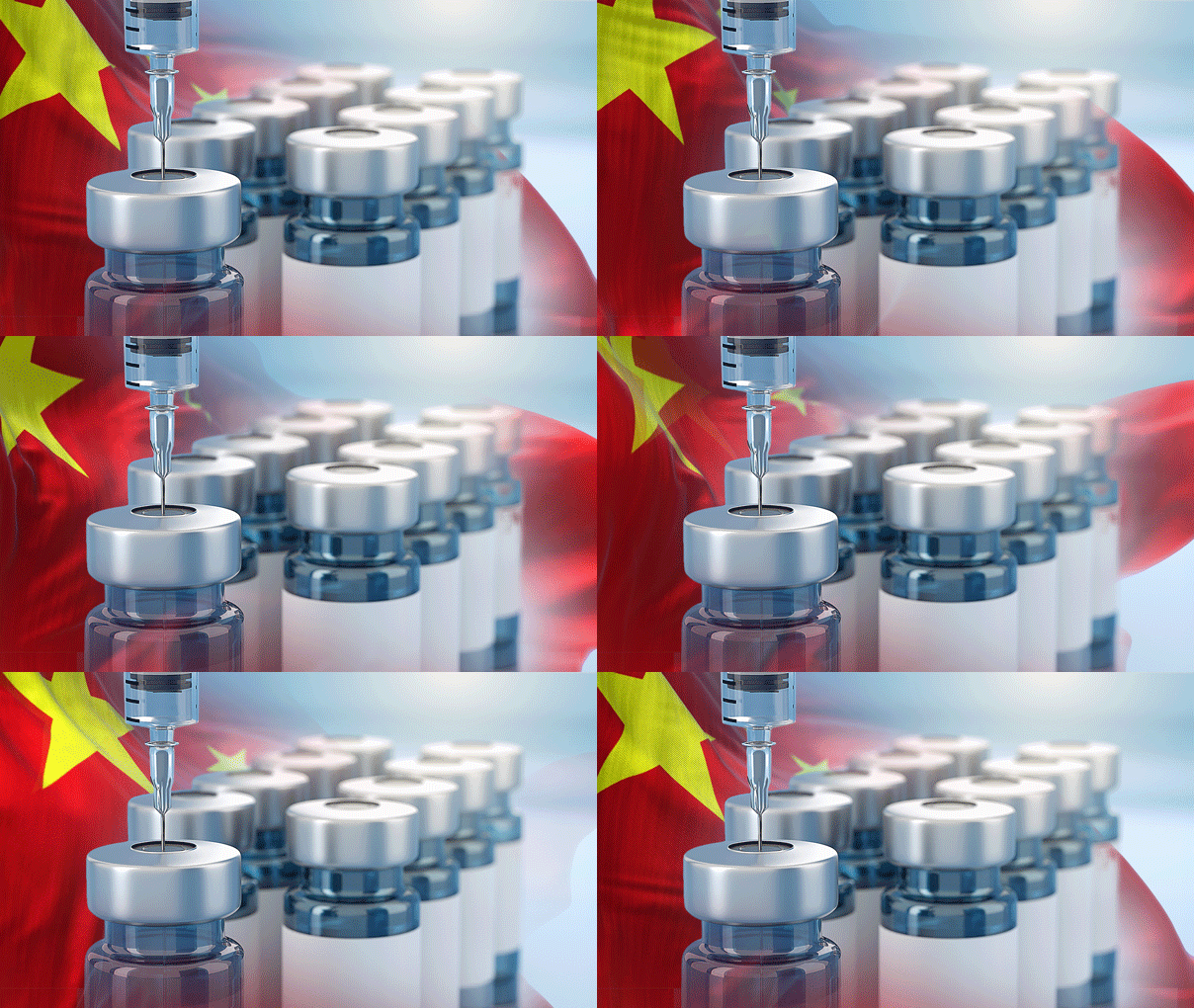
The United States has become dangerously reliant on China for prescription medicines. (iStock)
Americans are witnessing the offshoring of our medicine supply chains to a foreign adversary that has already exploited its control over critical minerals. The CCP has threatened to do the same with drugs. During the early days of the COVID-19 pandemic in March 2020, Chinese state media wire service Xinhua published commentary that threatened to impose export controls on pharmaceuticals to the United States and thus plunge America into a "sea of coronavirus."
America’s health infrastructure is dependent on a country with a history of weak intellectual property enforcement, state-backed chemical exports and adversarial trade behavior. The next pandemic or health crisis could be weaponized purposefully through our own medicine cabinets. The threat is concerning, but the risks are not hypothetical. Beijing’s lack of quality health standards has materially harmed Americans over the past three decades.
In 1996, an internal Food and Drug Administration (FDA) memo issued a stark warning: "We literally have no control over bulk drugs that enter the U.S." The next year, Congress took steps to address this threat by requiring foreign pharmaceutical companies to register with the FDA. Ten years later, however, the government had not enforced this requirement. The results were deadly. In 2008, hundreds of Americans were injured or killed by contaminated Heparin, a blood thinner used in dialysis, surgery and care to prevent blood clots.
US NEEDS TO BREAK CHINA’S SUPPLY CHAIN CHOKEHOLD TO WIN THE TECH RACE
Again, Congress acted and gave the FDA authorities and funding for foreign inspections by passing the Food and Drug Administration Safety and Innovation Act of 2012. What has often transpired, however, is a cat-and-mouse game with Chinese producers delaying inspections and hiding potentially concerning products, while Beijing delays granting visas for FDA inspectors.
This history underscores the double-crisis of China’s dominance over America’s pharmaceuticals. On one hand, poor regulation, cost-cutting measures and evasive behavior have endangered, harmed and in some cases killed Americans who rely on life-saving drugs.
On the other hand, the United States does not have alternative suppliers to tap. At present, we are stuck in the unacceptable position of hoping the CCP does not exploit this vulnerability, as they did with critical minerals. In their 2021 book "China Rx," authors Rosemary Gibson and Janardan Prasad Singh underscore this threat: "A poorly made drug could be the difference between life and death for those who take it. With medicine, there is no room for error. And it better be available when we need it." For these reasons, they warn that "worldwide dependence on a single country for life-saving medicines is breathtaking."
CHAD WOLF: TRUMP IS SERIOUS ABOUT THE CHINA THREAT AND IS REBUILDING OUR ARSENAL
Breathtaking, indeed, yet these concerns persist. In January, Illinois Democrat Rep. Raja Krishnamoorthi sent letters to multiple Chinese companies over concerns of mislabeled and counterfeit GLP-1 drugs. Shortly thereafter, Florida Republican Sen. Rick Scott introduced bipartisan legislation with New York Democratic Sen. Kirsten Gillibrand to institute country-of-origin labeling requirements for drugs and APIs. Awareness is growing, but Americans need their governing institutions to act.
Most urgently, President Donald Trump should revisit an executive order from his first administration that required the U.S. government to prioritize domestic pharmaceutical producers for government procurement, with particular attention given to antibiotics. Secondly, the administration should fully enforce the Drug Supply Chain Security Act and ensure real-time digital tracking of pharmaceutical products from point of manufacture to point of sale.
What has often transpired, however, is a cat-and-mouse game with Chinese producers delaying inspections and hiding potentially concerning products, while Beijing delays granting visas for FDA inspectors.
Meanwhile, Congress should pass legislation requiring that all APIs used in sterile injectable drugs be sourced exclusively from FDA-registered suppliers, with mandatory independent testing prior to compounding. Congress should also require the FDA and DHS to permanently blacklist foreign entities caught shipping misbranded APIs and penalize U.S. companies that continue to purchase from these sources.
This should be paired with diplomatic pressure on the Chinese government to crackdown on illegal API exporters. It should also include diplomatic initiatives with allies and partners to help track China’s exports of compounders transshipping through other markets to the U.S.
CLICK HERE FOR MORE FOX NEWS OPINION
Washington also needs a pharmaceutical foreign dependency strategy focused on reshoring API production and incentivizing domestic manufacturing. This could include tax credits, direct federal contracts and regulatory fast-tracks for companies willing to invest in American API plants. This would not be necessarily aimed at full autonomy, but rather an increased capacity for domestic manufacturing, making us less prone to shocks from foreign sources.
Congress should also increase criminal penalties for domestic distributors and compounders who knowingly use non-compliant APIs, particularly in products labeled for injection. Sanctions should be imposed on PRC entities involved in counterfeit API exports. Patient safety must be treated not just as a medical issue, but as a national defense priority.
CLICK HERE TO DOWNLOAD THE FOX NEWS APP
Finally, and perhaps most obviously, Congress should implement a blanket ban on the importation of compounders from China within a reasonable timeframe. This should be coupled with increased resources for Customs and Border Protection to adequately inspect de minimis imports from China.
The pharmaceutical market cannot be a regulatory afterthought. The integrity of our drug supply is vulnerable to the whims of strategic rivals. Washington must act now to ensure the integrity and independence of our healthcare system. Our health and sovereignty depend on it.
Michael Sobolik is a senior fellow at Hudson Institute specializing in United States-China relations.
CLICK HERE TO READ MORE FROM MICHAEL SOBOLIK
