





















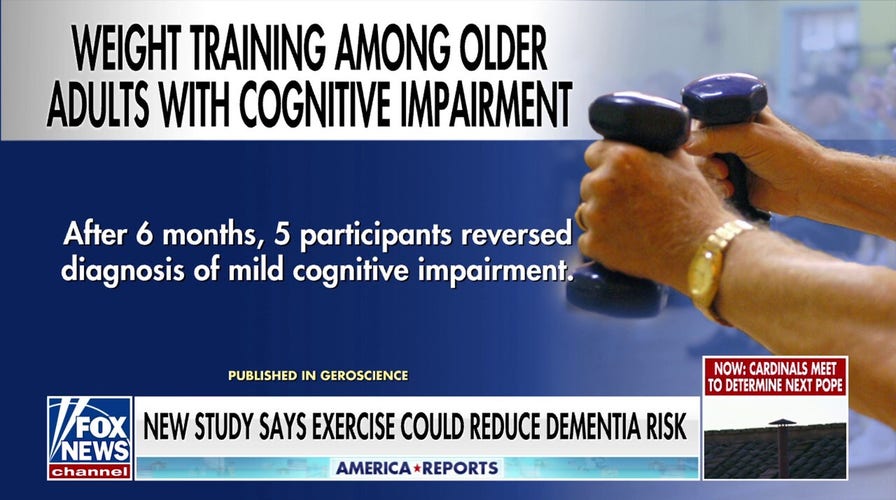
New study suggests exercise can reduce dementia risk
Board-certified rheumatologist Dr. Mahsa Tehrani discusses how weight training could reduce the risk of dementia on ‘America Reports.’
New research has identified a possible link between a person’s outlook on life and their risk of developing dementia.
The study, published in the Journal of the American Geriatrics Society, examined whether having higher levels of optimism could reduce the chances of cognitive decline over time.
Researchers analyzed data from more than 9,000 adults who were cognitively healthy at the start of the study. Participants were followed for up to 14 years, with more than 3,000 developing dementia during that period.
SIMPLE BRUSHING ROUTINE COULD REDUCE DEMENTIA RISK, SAY DENTAL HEALTH EXPERTS
Those who reported higher levels of optimism on a questionnaire had about a 15% lower risk of developing dementia compared to those with less optimism, even after adjusting for factors such as age, education, depression and major health conditions, according to a study press release.
The findings were consistent across demographic groups and remained largely unchanged after accounting for health behaviors and mental health status.

New research has identified a possible link between a person’s outlook on life and their risk of developing dementia. (iStock)
The results suggest that emotional and psychological factors may play a role in brain health as people age, the researchers noted.
"Our personal emotional and social resources — like how hopeful and positive we feel about the future — may be related to keeping our brains healthy," said lead study author Säde Stenlund, a social and behavioral sciences researcher at the Harvard T.H. Chan School of Public Health, in the release.
CLICK HERE FOR MORE HEALTH STORIES
The findings align with previous research linking optimism to other health benefits.
People with a more positive outlook were shown to have a lower risk of cardiovascular disease and may be more likely to live longer.
Study limitations
The researchers noted that the study was observational, meaning it only shows an association and cannot prove that optimism directly reduces the risk of dementia.
Other factors not measured in the study may have influenced the results, and changes in mood might be an early sign of dementia rather than a cause of it, they added.

Researchers said staying hopeful and positive may help protect brain health with age. (iStock)
Still, the findings point to a potential area for future research.
"Since optimism may be increased through relatively simple, low-intensity programs, it is helpful to understand how it is related to health in aging," Stenlund said.
CLICK HERE TO SIGN UP FOR OUR HEALTH NEWSLETTER
More studies, including clinical trials, are needed to determine whether boosting optimism could have a measurable impact on long-term dementia risk.
Fox News Digital previously reported that while dementia cases are rising, certain lifestyle habits may help reduce risk.

Experts recommend addressing conditions such as hearing loss, limiting alcohol consumption and quitting smoking, as these factors have been linked to cognitive decline. (Ourmindsmatter)
New York neurologist Dr. Joel Salinas previously told Fox News Digital that factors such as diet, exercise and social engagement play a key role in brain health.
CLICK HERE TO DOWNLOAD THE FOX NEWS APP
"It’s about putting the odds in your favor that you'll be less likely to develop one of these conditions, or at least delay the onset of symptoms," he said.
TEST YOURSELF WITH OUR LATEST LIFESTYLE QUIZ
Experts also recommend addressing conditions such as hearing loss, limiting alcohol consumption and quitting smoking, as these factors have been linked to cognitive decline.
Fox News Digital reached out to the researchers for comment.
Melissa Rudy of Fox News Digital contributed reporting.
